The brain is a remarkably complex and vital organ. It’s crucial not just for humans and the entire animal kingdom but even for machines. Think of it like a computer’s hard disk. A slight malfunction can disrupt the entire system, causing everything to go haywire. However, this comparison between a computer hard disk and an animal brain is simplistic at best. The gap between the two is vast. A malfunctioning hard disk can be easily repaired or even replaced. But the brain cannot be replaced, and repairing it, especially one that has been corrupted, is extremely difficult.
Over the past few decades, the disturbing events we have witnessed in our society, politics, culture, education, and healthcare suggest a fundamental problem with our minds. It seems that our brains have been so severely corrupted that we’ve undergone a complete transformation. Otherwise, how could anyone, anywhere in the world, ever conceive of desecrating a deceased person’s grave by setting it on fire? It doesn’t matter whose grave it was. The point is, it was a graveyard, a place we consider sacred. How could someone do such a thing without a severely corrupted mind?
There are more examples. A horrific example. A group of students from the Fazlul Haque Muslim Hall of Dhaka University fed a young man named Tofazzal before beating him to death. The young man was once the president of a union Chhatra League in Patharghata Upazila, Barguna. But he was not killed for that reason. For the past four years, he had been living a homeless life in Dhaka city, suffering from mental imbalance. Occasionally, when he went to the Dhaka University campus, his old acquaintances in the area would give him food and some money. Last Wednesday, when the young man went to Fazlul Haque Hall, he was arrested on suspicion of theft. Then, after feeding him, he was beaten to death. The brave men who killed him do not seem worthy of mental rehabilitation. However, the university authorities’ initiative to file a complaint with the police is somewhat encouraging.
Last Wednesday, a young man named Shamim was also beaten to death at Jahangirnagar University. He allegedly used to be a member of Chhatra League. It is reported that the sound of his moaning while he was dying was recorded and released on social media. Can someone be killed like this for political reasons? If those who are doing this can go, it means their minds are beyond repair. A different version of this incident is being found, which is no less horrific if it is true. According to this version, after brutally beating Shamim, he was taken to the university proctor. There, he was allegedly interrogated. Then the proctor informed the police. When the police arrived, Shamim himself got into the police car. Within less than an hour, news of his death came from the hospital. After that, protests and human chains were allegedly held at the university protesting Shamim’s death. So who killed him, and how?
A young man who played a key role in humiliating a woman (or a transgender person) on Cox’s Bazar beach has recently become the center of much discussion and has been arrested and sent to jail. Is the darkness of his mind any less than the solitary confinement of a prison? Such minds are now frequently visible. They are as prevalent on social media as they are on the streets. And what about the minds of the people who stood by silently watching the woman being humiliated? Do they not need reformation? Of course, when ‘mob killings’ go unpunished in various parts of the country and the state or government remains indifferent, it is safer for ordinary people to be mere spectators.
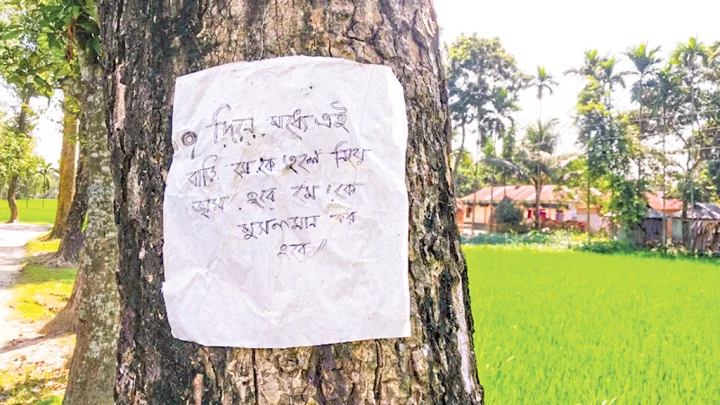
After the student-people uprising on August 5, many incidents have occurred, such as forcing teachers to resign, the scramble to occupy positions in the secretariat and other government offices, and harassing women, including customers, in residential hotels. What continues to happen is ‘mob killing’ and the persecution of minorities. While the media reports on ‘mob killings’, the other is less reported. On September 18, Wednesday, a 10th-grade Hindu girl was abducted in Fulbari, Kurigram. Most surprisingly, the abduction was announced in advance. On September 2, posters were plastered on trees in the Hindu neighborhood announcing this abduction. The posters also stated that the girl would be converted to Islam. The girl’s father filed a GD at the police station regarding the incident but did not receive any remedy. This treatment of minorities is also a manifestation of a sick mind. The number of people with such a mindset in this country is now quite large and is increasing. Who will reform these minds and how? If it cannot be done, will the country return to a healthy state?
“We are indeed living through a rather peculiar time. The newly appointed Vice-Chancellor of Rajshahi University recently expressed in a Facebook post, ‘We all want qualified people, but that qualified person must be from my party. Some want neutrality, but that neutral person should be a bit on my side.’ It’s quite an interesting time.”
The Vice-Chancellor, through this statement, likely hinted at the realities he’s facing while trying to manage the university administration. His perception of the current times seems to mirror that of many people in the country.
People are uncertain about how and when this phase will change, leading to growing anxiety and doubt. The interim government, however, is making efforts. As part of state reforms, they have formed commissions for six crucial sectors. Or rather, they have initiated the process of formation, which is yet to be completed. The commission formation process is facing some hurdles, but we hope it will progress. While this might lead to state reforms, will it reform people’s minds? Unless people’s mindset changes, no reform will be sustainable.