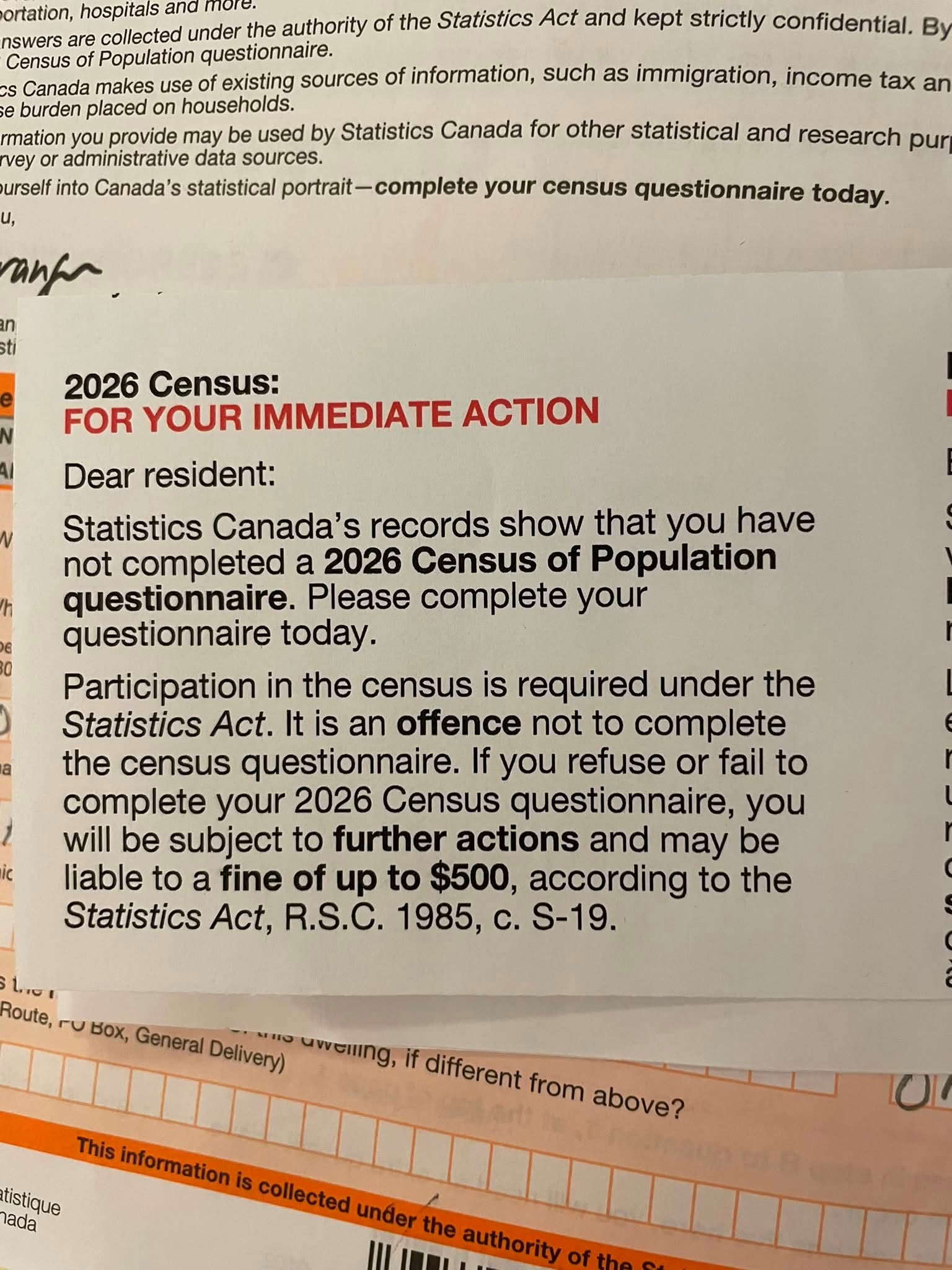
A significant portion of Canadians harbour doubts about Statistics Canada’s ability to protect their personal data and resist political interference, according to internal government polling obtained by Global News through an access to information request.
The survey, conducted between October 27 and November 2, 2025, found that nearly one in five Canadians 18.7 per cent do not trust the federal agency to safeguard their personal information from other government departments or law enforcement. This skepticism persists despite federal law explicitly prohibiting Statistics Canada from sharing any data, even with police, while all collected information is anonymized, stripped of personal identifiers, and encrypted.
Political independence is an even bigger concern. More than one in four respondents 25.1 per cent said they do not believe Statistics Canada operates free of political influence. Only 49.6 per cent felt it did.
On reliability, 62 per cent of Canadians rated Statistics Canada’s data as trustworthy, though 12.6 per cent outright rejected the agency’s ability to get figures right on the economy, society, and the environment. Another 23 per cent sat on the fence.
Those trust deficits showed up in real-world consequences this past spring, when an online campaign during the 2026 Census urged Canadians to return mandatory census forms marked “Return To Sender” a direct reflection of the institutional skepticism the polling had flagged months earlier.
Among the more striking findings was how few Canadians are familiar with the Labour Force Survey one of the country’s most consequential economic datasets. Nearly two-thirds of respondents, 65.5 per cent, had never heard of it. That matters because the LFS, published on the first Friday of every month, feeds critical indicators like national unemployment rates directly into Bank of Canada interest rate decisions.
“The ability of the LFS to deliver an accurate and representative picture of the Canadian labour market depends on widespread participation from selected households,” Statistics Canada spokesperson Carter Mann said. “Trust and understanding are therefore essential factors in the decision to respond to surveys.”
Statistics Canada’s image problem arrives at an awkward moment. The agency, operating on an annual budget of roughly $950 million, has been ordered to find $340 million in savings over the next four years a belt-tightening that could strain its capacity to collect and process data just as questions about that data’s quality are growing louder.
Randall Bartlett, deputy chief economist at Desjardins Group, acknowledged the credibility challenges but cautioned against writing off Canadian statistics altogether. “I think Canadian data is still very good in terms of quality, relatively speaking,” he said. “StatsCan still is one of the most credible statistical agencies on the planet.”
Still, Bartlett co-authored a June report Diagnosing the Data Quality Crisis after a Statistics Canada GDP report surprised professional forecasters, including those at the Bank of Canada. The report pointed to a convergence of problems: falling survey response rates, population data volatility, resource constraints, and a growing reliance on imputed rather than directly collected data.
The concerns are no longer confined to economists. At an April sitting of the House of Commons Citizenship and Immigration Committee, Julie Biron of Drummond Économique testified that StatCan’s unemployment figures for the Drummond, Quebec, census metropolitan area were nearly double what local researchers and the Institut de la statistique du Québec had independently found.
The discrepancy wasn’t academic. Employers in regions StatCan classifies as high-unemployment must complete costly local labour market assessments before hiring temporary foreign workers a burden Drummond businesses said was unjustified given the actual conditions on the ground.
At the Agriculture and Agri-Food Committee in November, Dalhousie University professor Sylvain Charlebois raised doubts about food inflation measurements. “We believe that inflation is often underestimated by Statistics Canada,” he told the committee, pointing to shrinkflation and delays in updating the basket of goods used to calculate prices.
Statistics Canada insists the polling, taken as a whole, paints a broadly positive picture, with a majority of Canadians viewing the agency as accurate, credible, and relevant. But the agency itself commissioned the poll precisely because it recognized the gap between perception and reality particularly around the surveys Canadians are legally required to complete.
Closing that gap will require more than a communications campaign. As Bartlett and his co-author noted, some problems yield to funding. Others like a generational slide in trust toward public institutions may prove far harder to reverse.