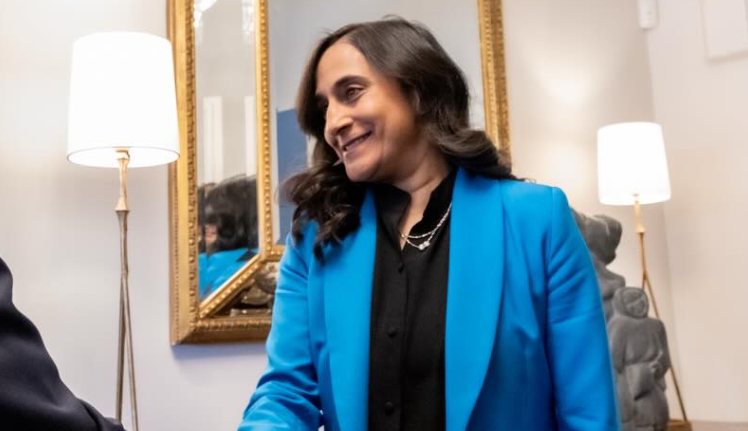
Mark Carney touched down in the Armenian capital this weekend as the first Canadian prime minister to attend the European Political Community summit, a gathering that brings together dozens of world leaders to wrestle with the continent’s most pressing challenges from the war in Ukraine to the shifting architecture of transatlantic trade.
The visit marks a rare and deliberate pivot for Ottawa. Canada has never before been invited to the EPC, a forum born out of the chaos that followed Russia’s full-scale invasion of Ukraine in 2022. That the invitation came at all extended to a non-European nation signals how much the geopolitical landscape has changed since the early days of the conflict.
Carney met Sunday with Armenian Prime Minister Nikol Pashinyan before the summit formally got underway, thanking his host for what he called an invitation arriving at a “crucial time” for European values and the broader rules-based order underpinning them.
The Prime Minister’s Office has been straightforward about what Carney hopes to take home from Yerevan: firmer commitments on Ukraine’s defence and a wider opening for Canadian trade and investment across Europe.
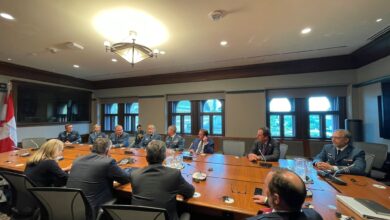
To that end, the prime minister’s schedule reads like a who’s who of the continent’s most consequential figures. Bilateral talks are set with Ukrainian President Volodymyr Zelenskyy, Spanish Prime Minister Pedro Sánchez, Italian PM Giorgia Meloni, Polish PM Donald Tusk, and European Parliament President Roberta Metsola. Carney will also sit down jointly with European Commission President Ursula von der Leyen and European Council President Antonio Costa a trilateral encounter that underscores the diplomatic weight Ottawa is placing on the trip.
Foreign Affairs Minister Anita Anand is accompanying Carney, adding heft to what the government is framing as a mission to deepen Canada’s European footprint at a moment when the continent is looking harder than ever at who its real partners are.
Back home and in academic circles, the visit is drawing mixed reviews not so much for what Carney is doing, but for what he appears to be leaving out.
Jean-François Ratelle, a University of Ottawa professor who specialises in the Caucasus region, expressed disappointment that the trip carries no visible commitment to Canada’s longstanding advocacy for Armenian democracy and peace-building in the South Caucasus.
“We are witnessing a complete change in our foreign policy,” Ratelle said, warning that Canada seemed to be abandoning a principled leadership role in favour of narrower commercial and strategic interests.
Canada has a complicated and deeply personal history with this part of the world. The previous Trudeau government repeatedly weighed in on the simmering conflict between Armenia and Azerbaijan over the Nagorno-Karabakh region a disputed enclave that sits at the heart of one of the post-Soviet era’s most tragic fault lines. When Azerbaijan launched a military campaign in 2023 that forced more than 100,000 ethnic Armenians to flee, Ottawa condemned the action, joined an EU security mission, and at one point suspended military exports to Turkey over fears that Canadian components were being routed to Azerbaijani forces.
Canada’s recognition as a champion of fragile democracies in former Soviet states was hard-won. Ratelle argues that work has quietly wound down since Carney took office, and that the embassy in Yerevan has become noticeably less visible on democracy promotion.
Carney’s office made no mention of the Nagorno-Karabakh conflict or Canada’s past advocacy in its announcement of the trip.
Others are less troubled by the prime minister’s focus. Achim Hurrelmann, co-director of the Centre for European Studies at Carleton University, sees a clear strategic logic at play.
“My guess is that he is primarily interested in the opportunity to meet EU leaders, and leaders from especially Ukraine and the U.K., all at once,” Hurrelmann said, noting that corralling so many decision-makers in a single room rarely happens outside of summits like this one.
Defence procurement, he suggested, is likely near the top of the real agenda.
The Yerevan summit is also something of a warm-up act. Carney is expected to travel to Turkey in July for the NATO summit a trip that will require its own delicate balancing act, given Ankara’s rejection of the term “Armenian genocide” even as Canadian officials, including Anand, took part in genocide remembrance events just weeks ago.
Canada was the first non-European country to attend these EPC meetings since the forum launched, joining a table that includes EU member states alongside Iceland, Turkey, and Ukraine itself.
Carney noted Wednesday that he had never previously visited Armenia. The last sitting Canadian prime minister to do so was Justin Trudeau, who came for the Francophonie summit in 2018.
He is expected to remain in Yerevan through Monday.