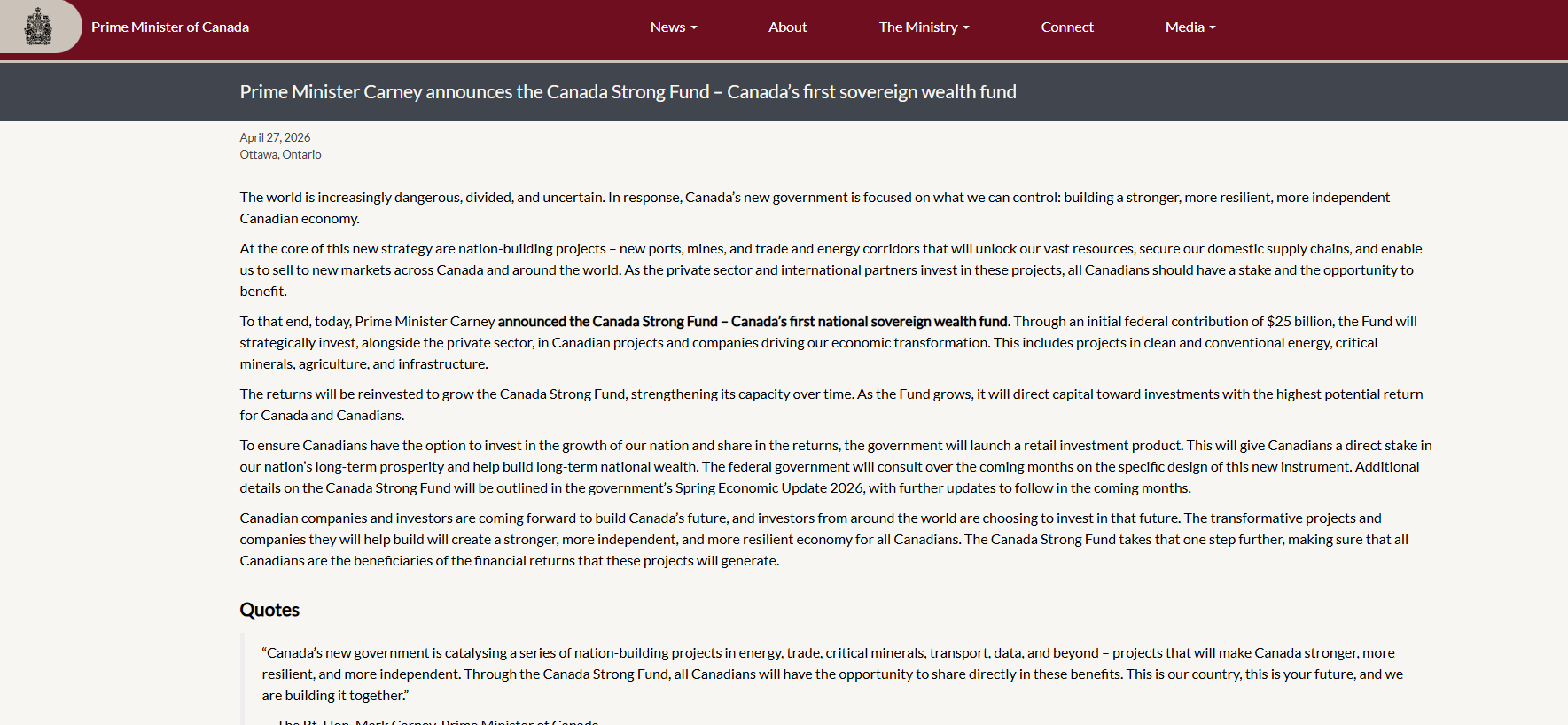
Prime Minister Mark Carney has been talking up Canada’s new $25 billion sovereign wealth fund by invoking one of the world’s most celebrated financial success stories Norway’s Government Pension Fund Global. But economists and finance experts say the comparison is more political flourish than financial reality.
“Many countries that are blessed with natural resources, like Norway, have sovereign wealth funds. Canada hasn’t had one. Until now,” Carney said when announcing what he’s calling the Canada Strong Fund, framing it as a vehicle to give Canadians a direct stake in nation-building infrastructure projects.
The problem, according to those who study these funds for a living, is that the two couldn’t be more different in purpose, structure, and funding.
Norway’s sovereign wealth fund formally called the Government Pension Fund Global is one of the largest institutional investors on earth, holding over US$2.2 trillion in assets and equity stakes in more than 9,000 companies across 70 countries. But here’s the key detail Carney’s comparison glosses over: the Norwegian fund is legally barred from investing inside Norway itself.
The entire point of Oslo’s model is to park oil revenues outside the domestic economy, shielding the country from the boom-and-bust volatility that comes with resource dependency. It’s a hedge, not a development engine.
“The Norwegian fund is prevented from investing in Norway. Everything is invested globally so that it can diversify the country from oil and gas price fluctuations,” said Sebastien Betermier, a finance professor at McGill University’s Desautels Faculty of Management.
The Canada Strong Fund, by contrast, is explicitly designed to do the opposite put money to work inside Canada, in major infrastructure and nation-building projects. That’s a fundamentally different mandate.
“Canada’s fund is aimed at investing in Canada to promote economic development. It’s a different category of sovereign wealth funds,” Betermier said plainly.
If it’s not Norway, what is the Canada Strong Fund? Betermier thinks the better comparison is the Gulf states funds from Qatar or the UAE that carry explicit domestic development mandates. Carney himself pointed to Singapore’s Temasek Holdings as a model, a state-owned investment vehicle founded in 1974 that started with domestic investments before expanding globally.
But even that analogy has limits. Temasek’s original purpose was to professionally manage Singapore’s large state-owned enterprises at arm’s length from government again, a different mission from what Ottawa is describing.
What Carney is proposing sounds less like a traditional wealth fund and more like a turbo-charged infrastructure bank with a patriotic pitch attached.
Norway’s fund works because it is fed by oil revenues money that flows in and gets invested, with only about three percent of returns allowed into the government’s annual budget. The principal is untouchable by law.
Canada has no such luxury on two fronts.
First, the federal government is running a deficit estimated at $66.9 billion in last year’s Spring Economic Statement. There is no surplus to seed a wealth fund with.
“Canada’s sovereign wealth fund will be based on debt,” said Kate Koplovich, senior policy analyst at the CD Howe Institute. “What that means is that the returns from the fund then have to be greater than the borrowing costs for the government.”
Second, Canada could theoretically tap oil and gas revenues the way Norway does but constitutional reality makes that a political minefield.
“The difference between Norway and Canada is Norway does not have provincial governments with nearly the power that we have in Canada,” said Concordia University economist Moshe Lander. “Any attempt to deal with the oil and gas industry at the federal level will instantaneously be met with pushback from Alberta, but also from Newfoundland and Labrador.”
There’s also the crowded-field problem. Canada already has the Canada Infrastructure Bank, the Canada Growth Fund, the Canada Pension Plan Investment Board one of the world’s largest institutional investors with over $780 billion in assets and Quebec’s Caisse de dépôt et placement du Québec.
Many of these vehicles already do precisely what Carney described at his press conference: unlocking capital for clean energy, trade infrastructure, and large-scale domestic projects.
How the Canada Strong Fund carves out a distinct lane without duplicating or undermining these existing institutions is, as Koplovich put it, “the million-dollar question.”
Perhaps the most unusual feature of the Canada Strong Fund is that everyday Canadians will reportedly be able to invest in it directly. No other sovereign wealth fund in the world operates this way, and the logistics remain entirely unclear bonds, portfolios, or some other vehicle have yet to be specified.
Experts are skeptical for a straightforward reason: retail investors tend to want returns sooner rather than later, and infrastructure projects don’t work that way.
“I expect this fund most likely to be invested in long-term infrastructure projects that can take years before cash flows come out. Retail investors are usually not that patient,” Betermier warned.
There’s also the competition problem. Canadian savers can already put their money into high-performing global equities. Convincing them to park dollars in a domestic infrastructure fund instead is a harder sell than the government may appreciate.
“Why would I want to invest my money in building some bridge in Canada when I can invest my money in some tech company in the U.S.?” said Lander.
The Canada Strong Fund may yet prove to be a worthwhile policy experiment. Large economies have found creative ways to mobilize public capital before, and Canada has genuine infrastructure needs. But wrapping it in the Norway comparison is, at best, a stretch and at worst, it sets public expectations that the fund was never designed to meet.
Norway built its wealth fund over decades, on the back of strict fiscal rules, unified resource control, and a clear mandate to protect future generations from oil dependency. Canada is proposing something newer, messier, and more politically complicated.
As Betermier summed it up: “I actually struggle to make the comparison to Norway.”
That struggle, it seems, is well founded.