Bangladesh is the name of this territory with two thousand years of ancient monuments. The early poet Bhusukupa pronounced the land, ‘Baj Nab Paua Khalen Bahyu/ Ada Bengale Desh Ludiu’ (Charyapad: 49) – the name ‘Ada Bengale Desh’ is sounded immediately after that name. The ancient poet Vusukupa did not forget to identify. That’s why he sang in the melody of Mallari Raga, ‘Aji Bhusuku Bengali Bhaili/ Nia Gharini Chandali Leli’ with the pain of this self-identification of ‘Bhusuku Bengali’ as an inevitable part of the geographical identity of the land of Padma as ‘Paua Khalen’. published Not only that, this country’s sadhana culture is also expressed in the first verse of this ancient song-dance-drama culture, ‘Lui Bhanai Guru Puchiya Jan’ (Charyapad: 1). Which guru? Verses 17 and 35 of the ‘Charyapad’ trace that Guru, as ‘Bazil’ and ‘Bajul’; Ahmad Sharif clarified in his Baul Tattva book — Bazil > Bajul > Baul. Apart from this, the history of the tradition of this land as a drama, dance, music-oriented ethnic group can be found in ‘Charyapad’, similarly there are various types of evidence available in books like Sandhyakar Nandi’s Ramcharit, Sharangadev’s Sangeetratnakar, Kahlan’s Rajatarangini, Lochan Das’s Ragtarangini etc.
Such was the spread of music-culture that it was so unstoppable and so impassioned that the continuation of antiquity continued into the Middle Ages. In fact, throughout most of the texts of the Bengali literary works of the Middle Ages, the seasonal diversity and cultural heritage of this land can be seen in almost the same continuity. If we take a closer look, the culture, pursuits and lifestyles of the rural towns of Bangladesh can be seen to be influenced by the cultural heritage of the ancient Middle Ages in a modified form. If not, the medieval tradition of Mangalkavya would not have continued in the form of spontaneous emotions in the contemporary presentation of Padma Purana, Bhasan, Behula Nachari, Padma Nachan, Jhapan etc. This trend was manifested in this year’s Bengali New Year celebrations. District administration of Chuadanga organizes Mansamangal’s traditional culture snake-centered performance Jhapan to celebrate New Year. In it, the dances and gestures of the sapures performing jhapan with the help of living snakes, as if the Purana is reborn in the cycle of the ages. Not only that, the marginal people of Bangladesh everywhere became addicted to various music-dance-drama by adopting various rituals from various mythological sources. While some documentaries surfaced on social media, the mainstream media only gave prominence to city-centric festivals and celebrations. It ignores the sentiments of the hearts of marginalized people and the vitality of the larger cultural heritage cultivated over thousands of years. Therefore, there is no interruption in the continuity of traditional cultural practices. I am presenting some examples of it in this essay.
For example, Kallol Talukdar, a son of Sunamganj released a video of Har-Gauri duet dance performed on the afternoon of April 12 this year in Chaihara village of Fenerbak union of Jamalganj upazila of Sunamganj district. The interplay of this duet dance expresses the union of the male power of the Sun, namely Shiva, and the symbolic maternal power of Dharitri, the union of Gauri. At the same time, he mentions the topic of Kalika dance as a result of primitive martial arts.
Much before this incident, on March 29, 2024, artist Sameeran Dutta, a resident of Ghughushal, Shahrasti, Chandpur district, released a video titled ‘Dhakir Saaj’ or ‘Kalir Saaj’ of mythological and folk characters dancing and acting. So that starting from the dance of Har-Gauri with the duet of Dhak-Kansar, the dance of Hanuman, Bagha, Asura, Kali and Angik act. Throughout the dance performance, one can witness the mythological scene of Mahisasu’s turn. It is known that artists of Sahapur village near Ghughushal village usually perform this kind of art-craft in groups every year in different villages in the yard of the village house or in the open space in front of the house under the light of hazak. Not just for a day, but for almost the entire month of Chaitra, this performance keeps the surrounding villages buzzing.
Hiranmoy Himangsu has released a video footage of folk dance performance at Chaitra Sankranti in Ghonabanda village of Dumuria, Khulna. This dance, which was held on April 11 this year, witnessed the spontaneous expression of the traditional creativity of the rural people throughout the night.
Painter and writer Jahangir Alam published two videos on his Facebook on April 12, 2024 of Sang Nritya Geet of Brahmagacha village of Raiganj Upazila of Sirajganj district. With the participation of the common people of the village, the way the singers danced in various costumes showed the innovative power and aesthetic sense of the folk people as well as the creativity of creating humor.
On the other hand, on April 13 of this year, photographer Kamal Das published a photograph of Har-Gauri with mobile dhaki of Barkhain Tailardwip of Anwara Upazila of Chittagong district on Facebook. In the photograph, it is seen, smeared with blue paint all over, dressed like a striped tiger skin, with a beard and mustache made of jute fibers and a garland of hair, and Shiva holding a trishul in one hand and a brass bell in the other. Next to him is Gauri aka Parvati wearing a beautiful colorful saree and golden crown. On one side of them is a dhaki in a golden dhoti, a white genji and a red turban on his head playing a dhaka, on the other side a pant-shirt clad cymbal player. A scene beside a waterlogged paddy field in the wilderness does not surprisingly blend the contemporary with the mythological! Otherwise, how can the modern-day pant-shirted man play cymbals in a very simple and simple manner next to the mythological character’s dress!
Apart from that, on April 13, 2024, I got some video images of the performance dance song of ‘Pat/Asan Shuddhi’ performed by the successors of Bala Sannyasi Nitaichandra Pari of Murarikhola village of Kalukhali upazila of Rajbari district on Facebook messenger through Manush Kaya Pramanik of that village. I learned that under the overall supervision of Kalyani Rani Pari, Bimalchandra Pari, Prasenjit Pari and their co-artists participated in this dance in the rhythm of dhaka music in the smoke of incense and holding sticks and mythological weapons. The antiquity of this tradition has been sustained by the present generation. In this case, it is also known that there is no gender discrimination between men and women in preserving the heritage.
Writer Shafiq Salim published a video of Chaitra Sankranti song performed by Rajbanshis on 13th April 2024 in Jabra village of Ghior in Manikganj district on Facebook. In this, the image of the primitive culture of the small ethnic group of this country has been revealed. This image is not only available among the small ethnic groups of the plains, but from various sources, information and descriptions of various customs and cultural traditions on the occasion of New Year’s Eve and New Year’s Eve have been found in various small ethnic groups of the hilly regions of Bangladesh. The manifestation of the deeds and traditions of the small ethnic groups of Bangladesh is truly full of unique beauty, but the spread of those traditions developed in the deep interior of nature is still largely unknown. In order to know and understand Him, as it is necessary to open the veil of one’s own intuition, it is necessary to have the simple and fierce courage to go into the deep proximity of nature.
The representative media of Bangladesh, even most of the city-centered cultural workers, cultural organizations, writers, intellectuals of this country are very indifferent about the movement of the traditional culture at the marginal level. At noon on April 11, he appeared in our Basantpur village of Shailkupa upazila of Jhenaidah district. On the basis of the poet and translator Anant Ujjal, he asked him to know the ancient history of Baul Sadhana in this country. And in harmony with that history, he visited Bihar, a pilgrimage site for the associates of this country. Arman Shah aka Nyangta Shah, a devotee of Panju Shah in Jhenaidah district visited Tamaltala village where he saw the tantra weaving method of Adi Yogis. Not only that, the main reason why he stayed up all night to see and understand the ancient rituals of Kushtia’s Harinarayanpur village, fire playing, thorn breaking, etc., is the main reason he wants to write an observational book on the marginal culture of Bangladesh.
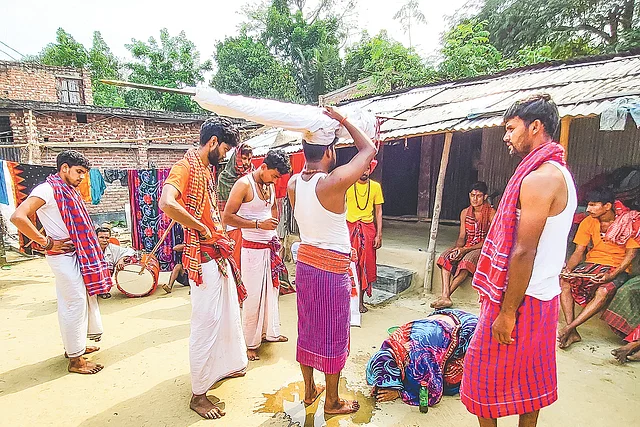
Among them, I got to know from the Facebook post of Shubojit Dutta, a writer and small paper worker of Maheshpur, Jhenaidah district, about a unique and unique performance of ours, ‘Balaki Dance’. Without delay, Sadhika went out with Srijani Tanya. After a continuous journey of about two and a half hours from Basantpur village, when we reach Maheshpur, Bhardupur. We rushed to Ramchandrapur village to see the Shiv Mandir, the newly built wooden chariot (the chariot was burnt in 1971 by the Pakistani army and its henchmen during the liberation war, it is being rebuilt after all these years), the century-old banyan tree, Sripat temple, neglected antiquities, pado zamindarbari etc. Amidst the hospitality and music of the village music, dramatist and cultured school teacher Shyampada Ghosh, I came to know that Ramchandrapur is an amazing village, which has four mosques and two temples. The Muslims-Hindus there are closely bound in the bond of mutual harmony. In the middle of our conversation came the sound of the hood. As soon as he noticed the sound, he saw a group of monks in the courtyard of a house. As they entered from one house to another, raising the sound of dhak and kansar, the women of the house came and covered the ground and made a place for the monk to stand with the patban on his head. After that, all the monks who came along were welcomed by lighting lamps, spreading the smoke of incense, blowing horns and blowing conches. Later, the host woman pours milk on the patban’s head alternately with neelkantha flowers, vermilion powder and puts her head on the ground and offers devotion to the patban holder monk. At the last stage, a monk takes a little powder of vermilion from the patban’s head and touches it on the forehead of the female devotee. Then Patban’s sannyasis started to go to other houses with the sound of drums and brass. However, another monk accepted a bowl of rice and raw vegetables from the woman as alms. Seeing this scene in several houses of Ghoshpara of Ramchandrapur village that day with these monks of Patban, a thought arose from the mind. That is, at the core of maintaining the continuity of this traditional ritual is definitely the offering of respectful bows and devotional aarti by rural women. It may be because of the respect and aarti that the Sannyasi Besh Tarun is getting in every house, that generation after generation has traditionally played a role in protecting this krita from within. If we can wholeheartedly offer this devotion to the traditional culture, then surely the traditional journey of the traditional culture of this country will never end.