Finally, Canada Gives Its Troops the Raise They Deserve, But Pay Alone Won’t Fix the Forces
Abdur Rahman Khan
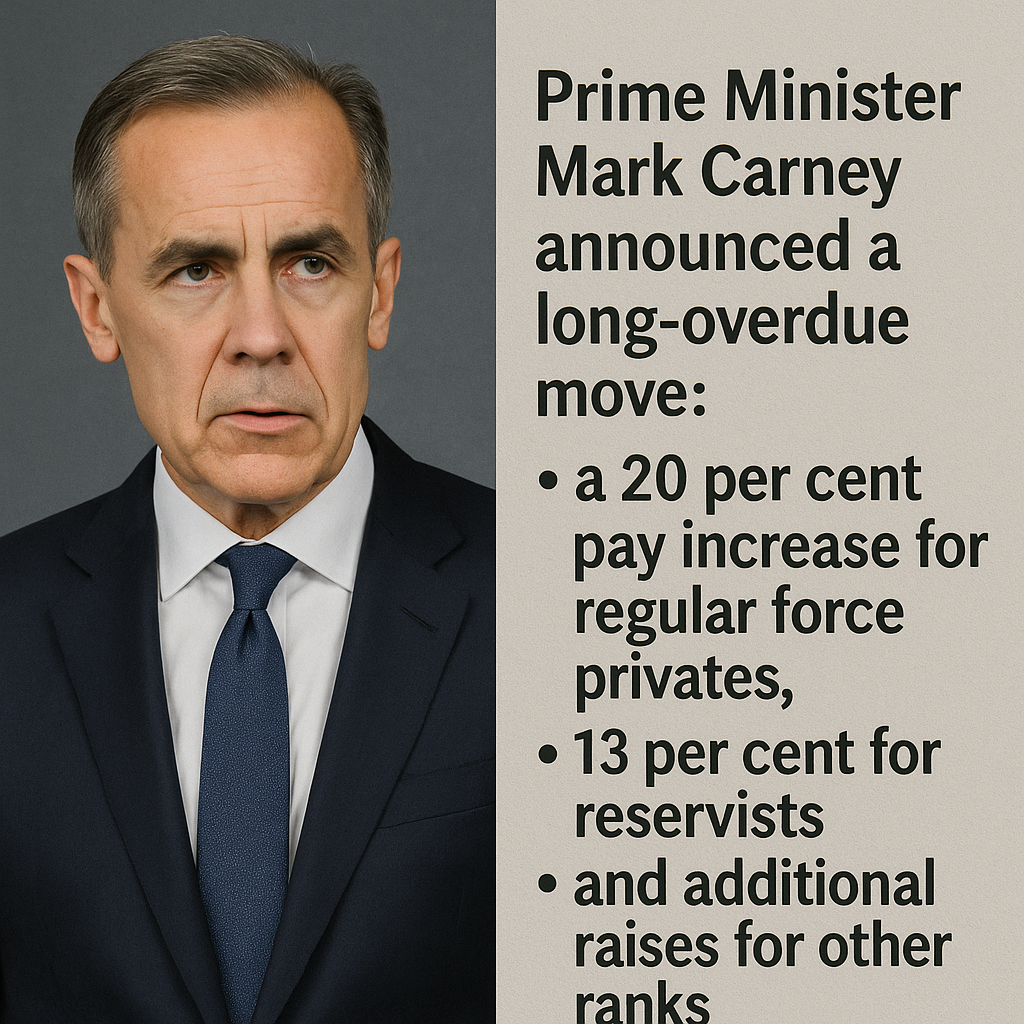
For years, members of the Canadian Armed Forces especially those at the bottom of the pay ladder have been asked to serve their country under conditions that frankly didn’t match the sacrifice required. On Friday, Prime Minister Mark Carney announced a long-overdue move: a 20 per cent pay increase for regular force privates, 13 per cent for reservists, and additional raises for other ranks. The changes, retroactive to April 1, send a clear message service in uniform is worth more than just a pat on the back.
This isn’t just a token gesture. Entry-level pay in the military has lagged for too long, and in a competitive job market, that’s a recipe for empty barracks. As Fen Hampson of Carleton University pointed out, if Canada is going to pour billions more into defence, starting with better pay at the ground level is one of the smartest moves it can make. It tells new recruits, we value you from day one.
But the timing here is telling. The military has been struggling to fill its ranks, and recent reports of racism and hateful conduct haven’t exactly made recruiting easier. Boosting salaries may not solve those deeper cultural problems, but it’s a necessary step if we want to keep the pipeline of motivated, skilled Canadians flowing into the Forces.
The scale of the investment is significant $2 billion annually and it’s part of a larger $9.3 billion push to meet NATO’s 2 per cent defence spending benchmark. On paper, that’s impressive. In practice, it has to translate into real results: more people joining, fewer leaving, and a military ready to respond when Canada calls.
The government’s targeted approach also deserves credit. Not everyone gets the same bump; instead, “stressed occupations” like vehicle and maritime technicians many operating at less than 75 per cent staffing — will get $50,000 bonuses. David Perry of the Canadian Global Affairs Institute is right: this kind of precision spending is smarter than a flat raise across the board.
Still, let’s be clear: this pay hike is a good start, but it’s not a magic bullet. The Forces need cultural reform, modern equipment, and streamlined recruitment processes that don’t take months to navigate. Pay alone won’t restore Canada’s military strength, but it can make the first handshake with a recruit a lot more appealing.
The government has finally stepped up on salaries. Now it needs to follow through with the rest of the reforms the Forces desperately need.


![Three smiling women sit on a colorful padded floor, posing with a large sign that reads Canada Child Benefit and its French translation, in a community setting with a pillow saying This Classroom Runs on Kindness nearby.]','Three women pose for a group photo indoors, holding a white board about the Canada Child Benefit and its French equivalent, with colorful circles in the design and a kindness-themed cushion nearby.'] }``` Wait formatting wrong. We must provide proper JSON. Let's craft properly. Provide 5 options. Ensure no stray quotes. Let's produce proper JSON. Use single quotes in descriptions? Must be double quotes. I'll provide array of strings. Ensure no stray characters. Let's do. } For safety. Let's output.} Let's craft final.} Wait earlier included typos. Let's deliver.]]>](https://www.thesouthasiajournal.com/wp-content/uploads/2026/07/12-2-390x220.jpg)