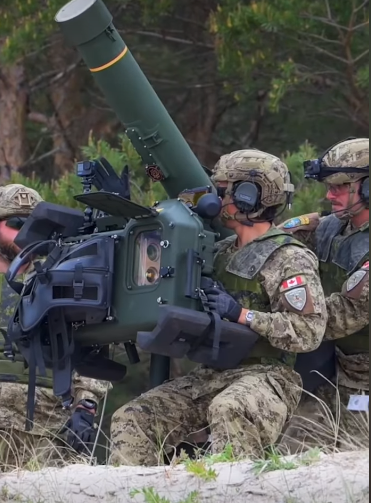
The world is a far more dangerous place than it was even five years ago. And yet, Canada continues to lag behind when it comes to defence spending — something that’s not just embarrassing among our NATO allies but increasingly unsustainable in a world defined by geopolitical volatility.
Defence Minister David McGuinty’s comments this week from Brussels suggest that Canada is finally waking up to this reality. Saying that the federal government is reviewing defence expenditures “from top to bottom” may sound like bureaucratic hedging, but there’s a more urgent message between the lines: we’re behind, and the clock is ticking.
The pressure isn’t subtle. NATO allies — especially the U.S. under President Trump’s renewed leadership — are pushing hard for all member states to increase defence spending to 5% of GDP. That’s a dramatic leap, particularly for Canada, which spent just 1.33% in 2023. Even hitting the 2% target — something Canada hasn’t done since 1990 — has remained elusive.
But today’s global threats are not theoretical. Russia’s ongoing war in Ukraine, China’s increasingly aggressive moves in the Indo-Pacific, and the unpredictability of regimes like North Korea and Iran are not problems that can be met with well-intentioned speeches and symbolic gestures. If Canada wants to be taken seriously as a contributor to global security, it must be willing to make the same hard financial commitments as its allies.
McGuinty pointed to a recent $6 billion investment aimed at securing the Arctic. That’s a start, but it’s just one piece of a much larger puzzle. The upcoming NATO summit in the Netherlands later this month is expected to seal the deal on a 5% defence spending commitment — broken down into 3.5% for direct military assets and 1.5% for related infrastructure and industry. If this goes through, it will mark the biggest defence spending shake-up since the Cold War. Canada cannot afford to be the odd one out.
It’s true that meeting such a goal will come with political and financial challenges. Defence budgets are massive, complex, and come with long timelines. For example, the proposed purchase of up to 12 new submarines — set to replace the aging Victoria-class fleet — won’t even see a contract awarded until 2028. That kind of slow-motion strategy may have worked in an earlier era of relative peace, but it no longer matches the urgency of the moment.
Prime Minister Mark Carney’s campaign promise to fast-track the 2% benchmark to 2030 is a step in the right direction, but we need more than promises. We need action. And fast.
Canadians are rightly proud of their country’s peacekeeping legacy and humanitarian commitments. But let’s not kid ourselves: credibility in today’s international alliances isn’t earned with good intentions — it’s earned with hard capabilities. Drones, missile defence systems, cyber warfare resilience — these are not luxuries. They are necessities.
If Canada wants to help shape the global order rather than simply react to its unraveling, the time to invest is now. No more foot-dragging. No more aspirational targets years down the road. It’s time for Canada to step up — not just as a member of NATO, but as a responsible and prepared global actor.