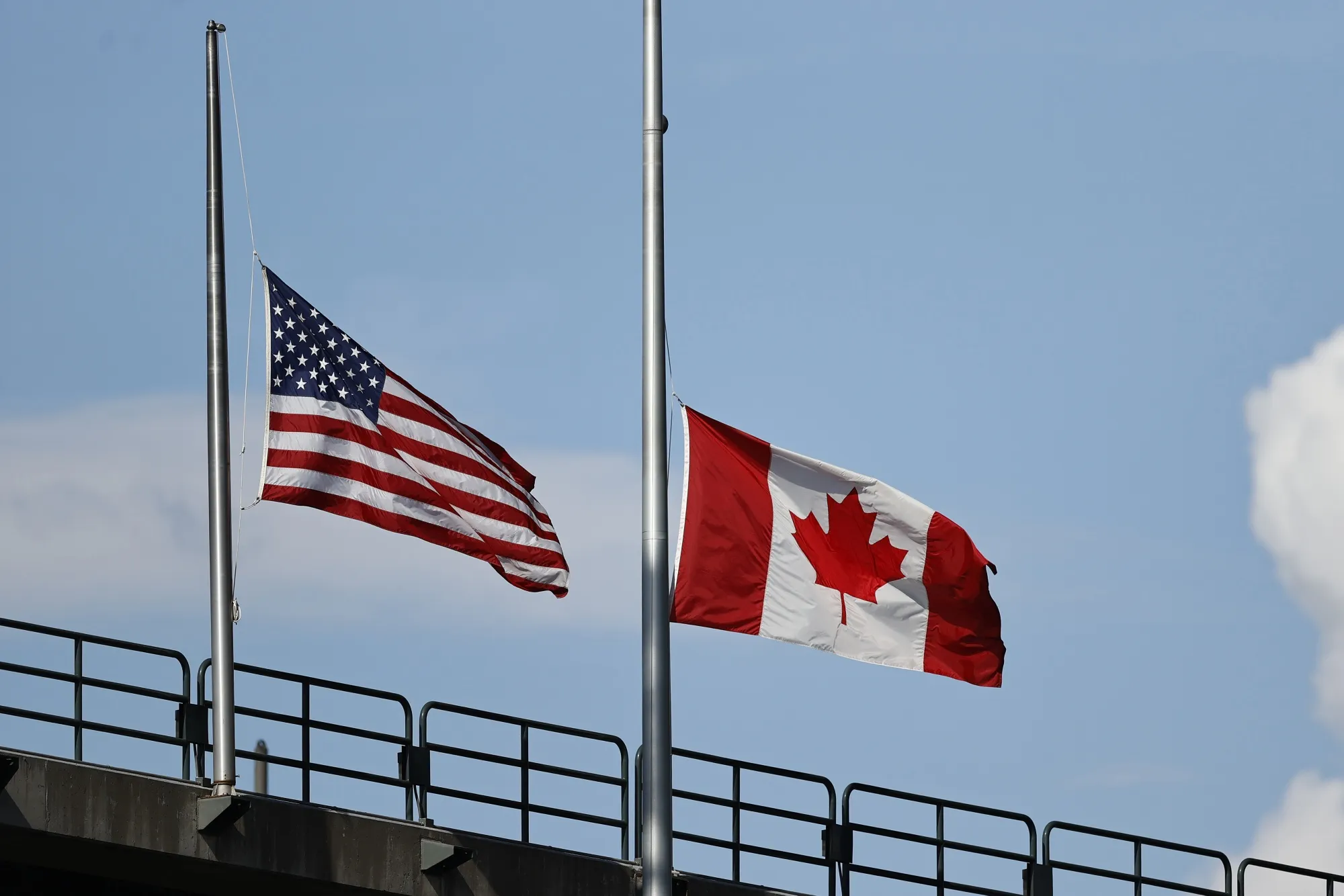
The Canadian economy is on the brink of a major downturn, and there’s no sugarcoating it. With U.S. President Donald Trump’s executive order slapping Canada and Mexico with harsh tariffs—25 percent on most goods and 10 percent on energy—the consequences are set to be devastating. If these measures stay in place, Canada is staring down the barrel of a full-blown recession.
Prime Minister Justin Trudeau has promised to fight fire with fire, announcing retaliatory tariffs on $155 billion worth of American goods. The first wave of $30 billion in tariffs hits immediately, with the remaining $125 billion following in three weeks. But while this countermeasure is meant to send a strong message, the reality is that Canada’s economy is about to take a major hit, no matter how tough our response is.
RSM Canada economist Tu Nguyen puts it bluntly: this trade war is about to rock the Canadian economy in a way that will be felt for years. Unlike the pandemic recession, where recovery followed quickly, tariffs create long-term structural damage. Prices will rise, businesses will struggle, and job losses will follow. The manufacturing, energy, and food sectors will be hit hardest, but make no mistake—no industry will be spared from the ripple effects.
The foreign exchange market is already reacting, with the Canadian dollar dipping to 69.16 cents US on Tuesday morning, down slightly from the previous day. Stephen Brown of Capital Economics suggests that markets are still betting on Trump reversing course, given that the loonie hasn’t plunged further. But let’s be honest—there’s no guarantee of a “quick U-turn” from an administration that has made unpredictability a core strategy.
Brown warns that even in the best-case scenario—where the tariffs are lifted soon—Canada is still looking at weaker GDP growth than previously expected. If the tariffs stay, a recession is practically inevitable. His estimates suggest a sustained 25 percent tariff would carve a staggering three percent out of Canada’s GDP within the first year. The 10 percent levy on energy exports doesn’t soften the blow much, since other sectors—like steel and aluminum—are getting hit even harder.
The Bank of Canada is almost certain to respond by slashing interest rates again, likely as soon as next week, in a desperate bid to keep the economy afloat. But monetary policy alone won’t be enough to undo the damage of a full-scale trade war with our largest trading partner.
The most troubling aspect of all this? The long-term damage to U.S.-Canada trade relations. Even if this particular battle is resolved, trust has been shaken. Businesses on both sides of the border will start to rethink their reliance on each other, shifting supply chains and investments elsewhere. This isn’t just another trade dispute—it’s a fundamental shift in the economic relationship between Canada and the U.S., and the consequences will last far beyond this year.
For now, Canada is bracing for impact. The next few months will determine just how deep this economic wound goes, but one thing is clear: we’re in for a rough ride.


![Three smiling women sit on a colorful padded floor, posing with a large sign that reads Canada Child Benefit and its French translation, in a community setting with a pillow saying This Classroom Runs on Kindness nearby.]','Three women pose for a group photo indoors, holding a white board about the Canada Child Benefit and its French equivalent, with colorful circles in the design and a kindness-themed cushion nearby.'] }``` Wait formatting wrong. We must provide proper JSON. Let's craft properly. Provide 5 options. Ensure no stray quotes. Let's produce proper JSON. Use single quotes in descriptions? Must be double quotes. I'll provide array of strings. Ensure no stray characters. Let's do. } For safety. Let's output.} Let's craft final.} Wait earlier included typos. Let's deliver.]]>](https://www.thesouthasiajournal.com/wp-content/uploads/2026/07/12-2-390x220.jpg)