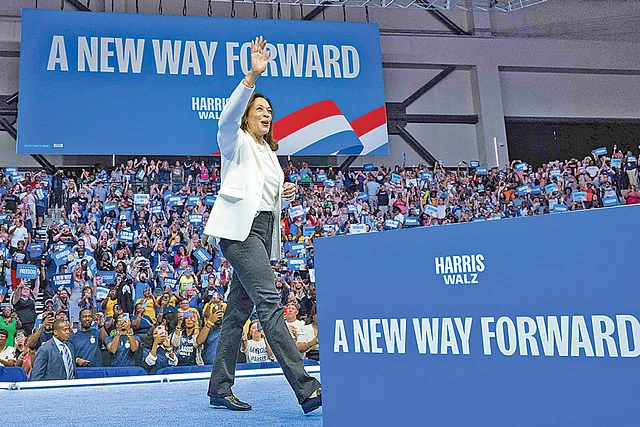
The convention of the Democratic Party just happened in Chicago, a huge show or exhibition. This show had it all: eye-catching melodious music. It was a blood-warming speech. There were devotional rituals. There were floods of tears. Hope was a promise. It was a happy moment. There was Oprah Winfrey (world famous media personality). And there were countless colorful balloons.
The manner in which Vice President Kamala Harris ‘presented’ herself at the convention was described as astonishing by television commentators. They had everything in that description. Kamala’s smile, her body language, the sweetness of her voice, and even her taste in clothes were not left out.
Autocracy or democracy—wherever you call it—in politics, there is always an element of showmanship. But variety entertainment has long been inseparable from American politics.
Famous American journalist H.L. Mencken hated politicians. He thought that most American politicians had no political knowledge. He was an excellent observer of political party conventions. That Mencken wrote in 1927, “In my eyes the greatest and most incomparable exhibition stage in the world is the election of the United States.”
But the question is, in order to stand in the election, should the candidates show their love for their families on stage? What does politics have to do with standing on stage and hugging and kissing spouses or relatives? Is the display of personal sincerity really necessary to win the hearts of voters?
Yes, that’s how it looks in America.
In a democracy, voters vote for the political party of their choice and the candidate who represents their interests. A person’s charisma plays a role in elections—it’s true. But most politicians lack the power to attract voters with a single personality.
Generally, Asian and European politicians are not as interested in selling themselves to the public as warm and romantic people during the polls as American politicians are.
Traditionally, people have expected such personal display tendencies from kings and queens. But they are not very interested in showing the personal lives of elected politicians.
Members of the British royal family saw themselves as elite and outside the ranks of the common people. People also saw them that way.
Queen Elizabeth II gave the BBC permission to reveal details of her domestic life. The BBC showed everything from the Queen’s flower garden barbecue to her tea with the children. Rani probably thought that she was born into the world as a symbol of popularity.
Although America was freed from the British monarchy in 1776, the White House still retains much of the splendor of that British monarchy. In this case, France is a little ahead. The republic there is still wrapped in royal splendor.
A candidate for the presidency of the United States has to behave like a member of the British royal family in a quasi-monarchical manner. He has to do a great advertisement of the scene of him standing on an open balcony and drinking beer with ordinary people like you and me.
Those running for president know very well that they are not like us. But they are ordinary people like us – they have to pretend.
On the stage of the US party convention, there are many expressions of affection, such as hugging, kissing and exchanging affection between family members. Similar things happen at other American events.
On the stage of the US party convention, there are many expressions of affection, such as hugging, kissing and exchanging affection between family members. Similar things happen at other American events.
Let’s take the Oscars. There the award-winning foreign artists concluded their speeches by saying a couple of words. But that cannot be seen in the case of American stars.
From primary school teachers to pet dogs, American stars stand on stage with trophies after receiving awards; They have to express their deep devotion to humanity.
Personal feelings such as love, sadness, hope and joy are usually expressed in the private sphere. When they become the subject of stage performances, they become misrepresentations of sensibility.
Politics, like the Hollywood film industry, is a ruthlessly competitive business where personal sentiments are sold. Fulfilling ambitions requires expressing love for beloved spouses and children in Hollywood and on the public stage of party conventions.
At the American Democratic National Convention, many good things were said, such as ‘looking out for one another’, ‘loving one another’ and ‘standing up for the poor and needy’.
All of these descriptions may fit many Americans. But the reality is that the United States is a much more ruthlessly competitive society and has far greater social and economic protections than other democracies. ‘Salesmanship’ is required to succeed here. This is especially true of men and women who must increase their sale value or ‘sale value’ to the public (as film actors or politicians do). In that sense, the politicians here are actually performers.
This is why common people are interested in the real life of actors and actresses and politicians. They want politicians to come before them in their true form.
That’s why we gossip about their personal lives. That’s why we want to show how much a politician loves his spouse. In this word we want to see them as a faithful husband or wife.
This is why we see actors at the Oscars and politicians at party conventions establishing themselves as trusted ‘performances’. As seen at the recently concluded Chicago event.