Why Pierre Poilievre’s Push for a “Castle Doctrine” in Canada Raises Tough Questions
Patrick D Costa
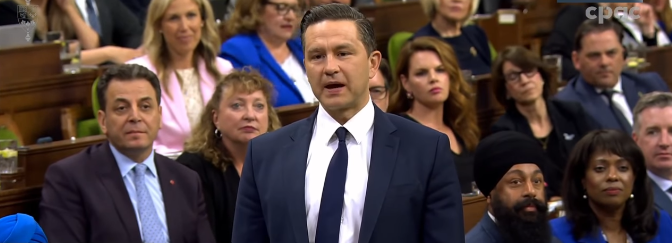
Conservative Leader Pierre Poilievre is calling for a major change to Canada’s self-defence laws — and at first glance, it sounds like common sense. If someone breaks into your home, you should have the right to defend yourself and your family. But his proposal to amend the Criminal Code so that force, even lethal force, is “presumed reasonable” in such cases deserves closer scrutiny.
Speaking at a press conference in Brampton, Poilievre argued that Canadians should not be burdened with “complicated, indecipherable legal doctrine” when faced with the terrifying reality of an intruder. His amendment would make Section 34.2 of the Criminal Code far more favourable to homeowners by presuming their actions are justified if an intruder poses a threat.
The backdrop to this push is a troubling case out of Lindsay, Ontario. A 44-year-old man was charged with assault after an altercation in his apartment with an alleged intruder armed with a crossbow. The intruder ended up in hospital with life-threatening injuries, and police defended the charges, insisting that defensive action must remain proportionate.
This is where the tension lies. The current law already allows Canadians to defend themselves and their property with “reasonable force.” But what counts as “reasonable” is deliberately flexible, judged case by case. Poilievre’s approach, while attractive to those who see homeowners unfairly punished, risks tipping the balance too far.
If lethal force is automatically presumed reasonable, do we risk creating a culture where “shoot first, ask later” becomes normalized in Canada? Our justice system has long resisted the American-style “castle doctrine” for good reason: it values proportionality and human life, even when a crime is being committed.
Of course, no one wants to see victims of crime dragged through the courts for defending themselves. The Lindsay case raises valid concerns about whether police and prosecutors are applying the law with enough common sense. But rewriting the Criminal Code to presume lethal force is always reasonable may not be the solution. Instead, we should be talking about clearer guidelines, better police discretion, and ensuring that victims of crime aren’t re-victimized by the legal system.
Poilievre’s proposal speaks to a real frustration Canadians feel — that the system too often seems to protect criminals more than victims. But turning self-defence into a blanket right to kill an intruder risks creating new problems, not solving the ones we already have.


![Three smiling women sit on a colorful padded floor, posing with a large sign that reads Canada Child Benefit and its French translation, in a community setting with a pillow saying This Classroom Runs on Kindness nearby.]','Three women pose for a group photo indoors, holding a white board about the Canada Child Benefit and its French equivalent, with colorful circles in the design and a kindness-themed cushion nearby.'] }``` Wait formatting wrong. We must provide proper JSON. Let's craft properly. Provide 5 options. Ensure no stray quotes. Let's produce proper JSON. Use single quotes in descriptions? Must be double quotes. I'll provide array of strings. Ensure no stray characters. Let's do. } For safety. Let's output.} Let's craft final.} Wait earlier included typos. Let's deliver.]]>](https://www.thesouthasiajournal.com/wp-content/uploads/2026/07/12-2-390x220.jpg)