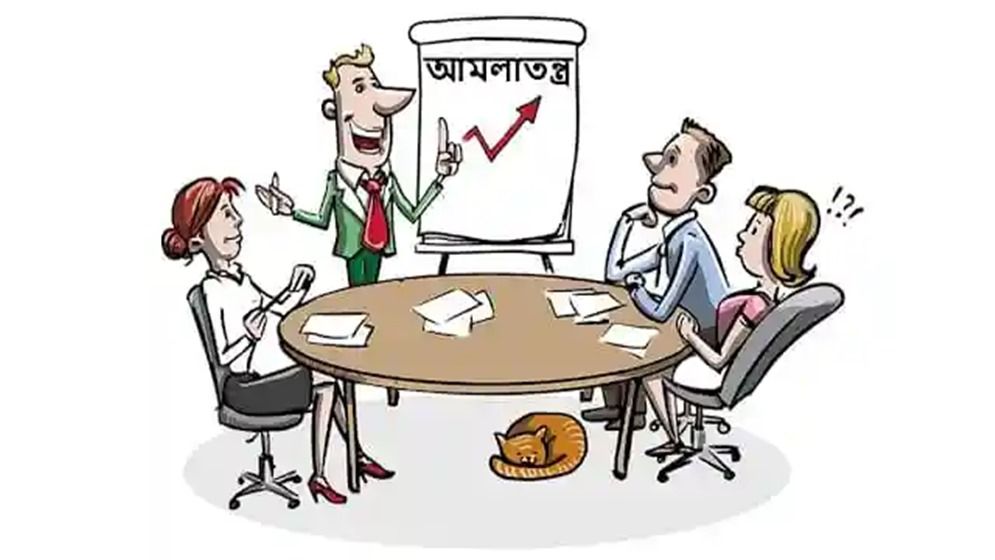
In a meeting of secretaries held on November 3 with the head of the White Paper Committee on Economy, Dr. Debapriya Bhattacharya, they claimed, ‘During the previous government’s tenure, public administration was completely hostage to politics.’ I humbly say that their statement is not the complete truth, but only a partial truth. The bulk of the truth is that the bureaucrats were more hostage than they were at that time, some of them took politicians hostage and broke jackfruit on their heads. Information from the Anti-Corruption Commission (ACC), Transparency International Bangladesh (TIB), various local and international research institutions, and mainstream media shows that in the last 15 years, some of the bureaucrats were not behind politicians in any way in accumulating wealth at an illegal and unreasonable rate. This is true in terms of building wealth within the country, as well as in terms of illegally smuggling wealth abroad and acquiring ownership of houses, flats, and other properties there. Disgusted and annoyed by such a trend, the then Foreign Minister Dr. AK Abdul Momen had openly expressed his annoyance and discomfort over these incidents of money laundering by bureaucrats. So, if bureaucrats were hostages to politicians, how did some of them become owners of so much illegal wealth in the country and abroad overnight? If they were hostages, this should not have happened.
However, it is certainly true that bureaucrats identified as non-Awami League members were widely deprived and oppressed throughout the tenure of the previous government. Most of them were either made Officers on Special Duty (OSD) or were posted in various subordinate or unimportant positions, creating a situation where there was no opportunity for them to work or contribute. However, there is no doubt that the remaining majority was very powerful. And so powerful that ministers, members of parliament and others regularly complained that bureaucrats were not listening to politicians. The then Agriculture Minister Dr. Abdur Razzak directly complained at an event organized by the Ministry of Industries that, ‘Bureaucrats…don’t care. They do as they please. I am saying this with responsibility as a minister’ (Prothom Alo, 23 May 2023). Such complaints from politicians were frequent at that time. Even while standing in the National Parliament, members of parliament raised such complaints. They also expressed their grievances to the then Prime Minister on various occasions. But there was no remedy. In fact, it was the bureaucrats who actually ran the country at that time with the decisions and indulgence of Sheikh Hasina and they were the real government. As a result, the bureaucrats’ statement on November 3 that they were completely hostage to politicians during the previous government is completely untrue.
If the then Inspector General of Police Benazir Ahmed or the National Board of Revenue (NBR) member infamous for the goat scandal, Matiur Rahman, or many other members of the bureaucracy who built up mountains of wealth during the previous government were truly hostages, how could this be possible? Rather, it can be said that there are very few bureaucrats in the country who were close to the then rulers who have not become inflated by the splendor and splendor of their wealth in the last 15 years. During this time, they have instead taken the politicians hostage and arranged their own affairs not only through various informal strategies, but also within the formal structure. Is the salary structure and ancillary benefits that they have secured for themselves by applying this hostage strategy so much in line with the overall economy of the country and the income and earnings of people from other classes of society? Not at all. Rather, because of all this, 43 percent of the budget is now in the hands of bureaucrats, that is, this 43 percent of the money is now being spent on their salaries and related operating expenses. Still, should we accept that bureaucrats were hostages to politicians during the previous government?
Sheikh Hasina, surrounded by Darvesh-Kader-Assad-Hasan, is responsible for the fact that the past three general elections in the country could not be participatory, as much as the arbitrary decisions of Sheikh Hasina, surrounded by Darvesh-Kader-Assad-Hasan, is responsible, as is the active participation and cooperation of bureaucrats in these undemocratic activities. Without the bureaucrats, especially the fuel and cooperation, it would not have been possible for Sheikh Hasina to organize such a one-sided election in any way. However, the responsibility for the one-sided election is now being imposed only on politicians and they are being judged – bureaucrats are completely out of reach. But the ballots scheduled for the 2018 general election day were in the hands of the administration the night before and they were also the ones who sealed them. And if that is the case, why won’t action be taken against the relevant members of the administration for their direct involvement in the malfeasance of organizing such an illegal election? Why won’t the Election Commission as well as the bureaucrats be held responsible for the fabricated, inflated results by showing abnormal voting in the 2024 election?
Similarly, bureaucrats prepared the DPPs of the mega projects with no prospects and sent them for ECNEC approval. And it is now well known that most of the corruption during the implementation and implementation of these projects took place through them. At that time, they were the ones who facilitated the irregular exemption of crores of taka for dishonest entrepreneurs. The incidents of embezzlement of crores of taka from there by forming the so-called stimulus fund in the name of Corona and the Ukraine war were never possible without the cooperation of bureaucrats. Was money laundering abroad ever possible without the cooperation of banking and bureaucratic processes? The establishment of quick rental power plants on terms against the public interest and the conclusion of agreements on the import of electricity from Adani’s Gadda power plant, many purchases under various ministries without tenders, the allocation of plots, flats, houses and land under RAJUK and National Housing Authority to loyalists in violation of rules and regulations, etc., were all done without the direct participation and cooperation of bureaucrats. No child would believe this. So why should only politicians be brought to justice for these corruptions? Why shouldn’t bureaucrats be brought to justice for the same charges?
In short, the bureaucrats’ claims that they wanted to convey in their November 3 speech that the wrongdoings they were involved in during the previous government were not intentional, but were merely done under pressure from politicians, are completely unacceptable. Even then, if they want to prove their innocence, they should do so by going to court. But bureaucrats, like politicians, need to be brought to court for those wrongdoings. So far, politicians and bureaucrats have been under a shared distribution arrangement. To get out of this, we need to abolish that permanent arrangement and make the politician-bureaucrat relationship a follower of the state’s interests first and foremost. Among the reforms the interim government is talking about in various sectors of the state, I think this issue of redefining the politician-bureaucrat relationship should be one of the biggest reforms.

![Three smiling women sit on a colorful padded floor, posing with a large sign that reads Canada Child Benefit and its French translation, in a community setting with a pillow saying This Classroom Runs on Kindness nearby.]','Three women pose for a group photo indoors, holding a white board about the Canada Child Benefit and its French equivalent, with colorful circles in the design and a kindness-themed cushion nearby.'] }``` Wait formatting wrong. We must provide proper JSON. Let's craft properly. Provide 5 options. Ensure no stray quotes. Let's produce proper JSON. Use single quotes in descriptions? Must be double quotes. I'll provide array of strings. Ensure no stray characters. Let's do. } For safety. Let's output.} Let's craft final.} Wait earlier included typos. Let's deliver.]]>](https://www.thesouthasiajournal.com/wp-content/uploads/2026/07/12-2-390x220.jpg)