
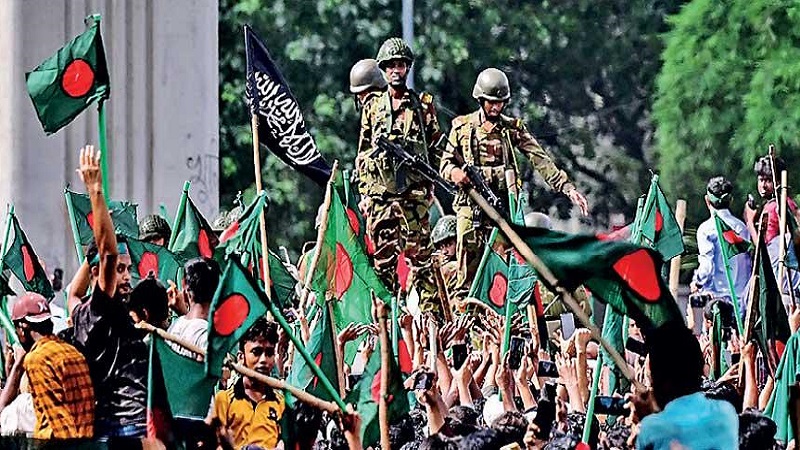
History tells us of several revolutions. The Russian and French Revolutions are among the most famous. In this century, we’re hearing echoes of a student revolution in Bangladesh that toppled the Sheikh Hasina government.
Last month, protests led primarily by students began over a controversial quota system in government jobs.
From 1975 to 1990, Bangladesh was under military rule. However, multi-party parliamentary democracy was restored in 1991, and since then, the military has not challenged it. During the current crisis, the army remained neutral. At the request of the army chief, Sheikh Hasina fled to India. This was because the army had refused to fire on the protesters.
Instead of the army, the police were blamed for the excessive violence against the protesters. After the interim government took power, the police became ineffective. Students maintained law and order in cities and even managed traffic. Police stations were empty, and police officers fled in fear.
Nearly 650 protesters were killed in this movement, and approximately 200 lost their eyesight. Reports indicate that many of the injured had bullet wounds above the waist.
Pursuing a policy of massive repression-
This is where the revolution in Bangladesh differs from the revolution in Sri Lanka. The movement began as a non-violent middle-class protest involving students. But after the ruling Rajapakse faction began cracking down, the protests became increasingly political and more violent. Until then, the police were passive rather than violent and the army was neutral. However, its leadership has strong loyalty to Gotabaya Rajapaksa.
However, the protests succeeded in toppling the Rajapakse regime. But the political changes demanded by the people have not been able to take any action, especially against corruption. All previous claims are nullified as governance is filled by a conservative, neoliberal leadership devoid of political knowledge. They have not adopted any positive alternative proposals against the existing many harmful measures.
Now what will happen in Bangladesh? Will the expectations of the people be realized through the new interim government led by economist and Nobel laureate Muhammad Yunus, or will it return to the old form after a few days?
Let’s take a look at the reasons behind the protests. Sheikh Hasina’s political history is important to understand that. She is the daughter of Sheikh Mujibur Rahman, who led the struggle against Pakistani rule in the then East Pakistan. After winning the war against Pakistan in 1971, Bangladesh was created as a new state.
But Sheikh Mujibur Rahman’s tenure as prime minister of the new nation was short-lived. After only a few months in power, he was killed along with his wife and three sons in a military coup in August 1975. Sheikh Hasina survived because she was abroad. He later took over the leadership of the Awami League formed by his father and returned to Bangladesh in 1981 to lead the struggle against military rule. The last military ruler Lt. Gen. Hussain Mohammad Ershad was forced to step down under pressure from Sheikh Hasina and her supporters.
Although Sheikh Hasina’s political rival Khaleda Zia and her Bangladesh Nationalist Party (BNP) won the next election in 1991, Sheikh Hasina accused her of rigging, eventually forcing her to hand over power to a caretaker government, and Sheikh Hasina was elected prime minister in 1996.
Powerhouse of power-
Awami League and BNP are two main forces in Bangladesh politics. Awami League has always been a moderate party, countering the threat of radical Islam. Bangladeshis are religious, but the political outlook remains secular, and analysts say this is due to the country’s Bengali identity. Like other countries in South Asia, Bangladesh also has a majority and a minority. Hindu minorities have suffered attacks and arson during recent violence; But as far as we can judge from here, it doesn’t seem to be on the scale of the 1983 ethnic riots in Sri Lanka.
Bangladesh has progressed economically during the regime of Sheikh Hasina. Its per capita income has surpassed that of India, and the country’s garment industry has grown to such a size that it is now called the ‘garment factory of the world.’ Women’s representation in the workplace has also improved considerably over the past decade.
So, why this sudden response?
It’s not sudden, it’s a long-standing grudge. Here too the Sri Lankan experience can be shared – rapid spectacular growth under a populist leader, resulting in nefarious politics and nepotism, large-scale corruption and the erosion of democracy. Political opponents and rights activists were jailed and even disappeared. Even Dr. Muhammad Yunus has been jailed. During the reign of Rajapaksa, the people of Sri Lanka also lived in fear like Bangladesh.
Sheikh Hasina’s political career may be over. He is stationed at an Indian airbase. India has friends and its government maintains excellent relations with its neighbour. He did not seek political asylum. His son says he will return to Bangladesh. If he sought political asylum, Britain would no doubt be an obvious choice; His niece is a British MP. But he cannot do this from India and Bangladesh has an extradition treaty with New Delhi.
But his Awami League can show strength from home. The interim government will have to tread carefully until the elections are held. The Jamaat-e-Islami party is also under consideration there. According to some analysts, it is moderate compared to other Islamist parties.