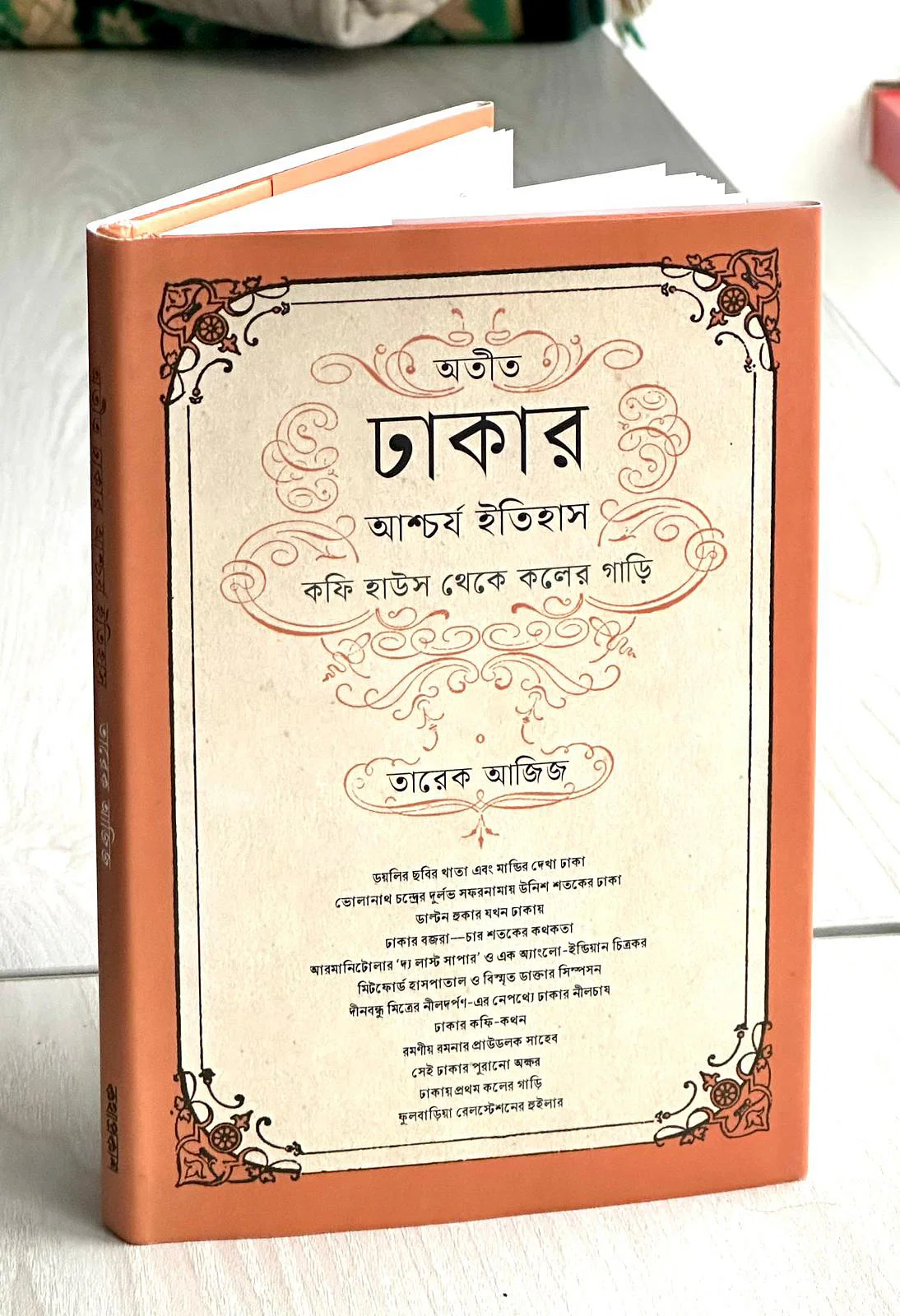
Dhaka city is like a treacherous lover to the residents. The city draws all like Masud Rana, but binds only a few. Despite being the heart of Bangladesh, the history of Dhaka is largely obscure to us. As a personal interest, I try to read books on the history of Dhaka whenever I get a chance. Tarek Aziz’s Amazing History of Dhaka’s Past: Coffee House to Call Car is also read out of that interest.
A collection of discussions has been compiled from several long essays. The author has collected all the important information in short articles. Historians often lose the flavor of writing by overloading with information. Tarek Aziz has gone down that way.
The book begins by describing Charles Doyley’s joining as a collector in this swampy city of Dhaka in 1808. And its last essay stopped well past the mid-twentieth century, when the Fulbaria railway station branch of bookshop Wheeler & Company closed in 1968. With that in mind, it can be said that the book contains the fragmentary history of Dhaka city for one and a half hundred years. And the 10 articles between the two mentioned articles discuss some events that happened in this city (Bholanath Chandra’s trip to Dhaka or the arrival of the call car in Dhaka), some people who worked for this city (doctor Alexander Simpson who turned Mitford Hospital into the most reliable medical institution in East Bengal or Ramana Robert Proudlock, who wanted to make the garden a second Paris) and some civic accessories (the introduction of coffee-making in Dhaka or the advertising signboards of Dhaka).
To be honest, those interested in the history of Dhaka, who have read Muntasi’s Mamun even half attentively, know many of the characters or events of the book in question. Meezanur Rahman’s Dhaka Purana should also be mentioned here, there are also references to many details of Tilottama Dhaka’s past, whose repetition can be seen in the intended compilation.
However, the value of Tarek Aziz’s book is that it often adds a new information or two to the information found in previous books. For example, about the construction of a race course by Mr. Charles Dodge. That information is well known to those interested in the history of Dhaka. From the reference book, it was known that “Doge’s Folly” was the first meeting place of the coffee drinkers of Dhaka. It can be said that the wheeler’s book shop at Fulbaria railway station is also the subject. While Meezanur Rahman’s writing is light, Tarek Aziz has detailed Wheeler’s story.
As a tourist interested in the history of Dhaka, the three articles seem quite new. An essay on the famous botanist Dalton Hooker’s visit to Dhaka, Charles Pott, the one-time headmaster of a Pogoz school and the artist of ‘The Last Supper’ at Armanitola Church, and another essay on the history of the Bajra in Dhaka. In particular, the last article summarizes the 400-year evolution of the Dhakai Bajra in great detail.
Along with the writing, some photographs and decorations have enriched the beauty of the book. Mention should also be made of the references added at the end of each article. In the future, if someone is going to search for Dhaka, the relevant sources will work like a gold mine for him.
The most important thing is that the author’s compassion for Dhaka’s past impresses the reader in the whole book rather than the historian’s details. In this dynamic era of Tik Tok-Reels, it is not easy to make a panoramic picture of 150 years of the beautiful yet monotonous Dhaka city. The book is a must read for the reader who wants to explore the history of Dhaka city with love.