Minister Hodgson Says Natural Resources Are Ottawa’s Strongest Leverage in U.S. Trade Talks
Arshad Khan
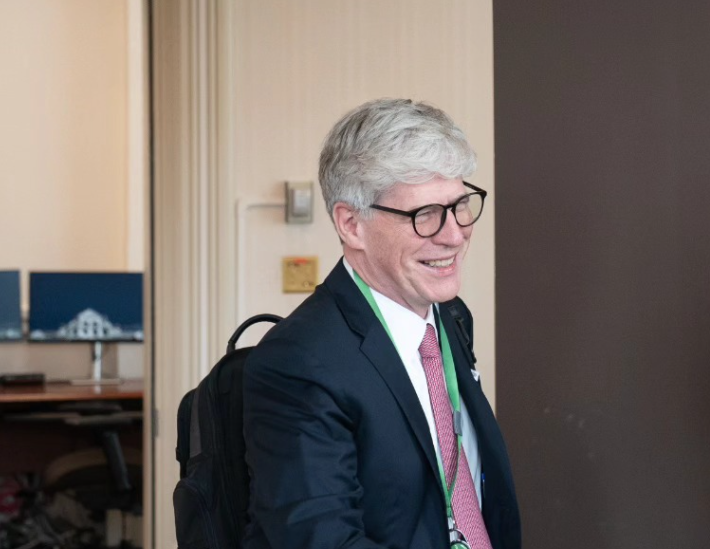
Canada’s Energy and Natural Resources Minister Tim Hodgson made no attempt to mince words on Friday, telling a Toronto audience that the country’s vast energy sector is its most powerful bargaining chip as the clock runs down on the renegotiation of the Canada-U.S.-Mexico Free Trade Agreement, known as CUSMA.
“I spent my whole life doing deals,” Hodgson told the gathering. “Ultimately, it is about knowing which cards are your best and playing them effectively. Energy, electricity, forest products, minerals these are our best cards.”
The minister, now entering his second year in the role, framed energy not simply as an economic asset but as a strategic instrument one that Ottawa has yet to fully exploit at the negotiating table.
The numbers back up Hodgson’s confidence. According to an analysis by TD Bank, Canadian energy exports spanning crude oil, natural gas, and electricity reached nearly $170 billion in 2024 alone. Strip that out of the bilateral trade picture, and the balance of power shifts dramatically: without energy, the U.S. actually runs a trade surplus with Canada of roughly C$60 billion, or about US$45 billion.
That single data point may prove to be one of Ottawa’s most effective arguments. Any U.S. tariffs on Canadian crude, TD Bank estimates, could send American gasoline prices jumping by as much as 30 to 70 cents per gallon a politically toxic outcome for any administration.
The electricity relationship is equally critical. In 2023, Ontario alone powered the equivalent of 1.5 million American homes across Michigan, Minnesota, and New York. Canada is also a significant supplier of critical minerals that the U.S. increasingly depends on for its manufacturing and technology sectors.
Beyond the trade fight, Hodgson sketched out a broader domestic energy vision for the year ahead. He said his ministry will work to develop a coherent national strategy around electricity and nuclear power, arguing that every major economic ambition Canada holds from artificial intelligence infrastructure to advanced manufacturing and mineral processing ultimately depends on having reliable, affordable power on the grid.
By spring 2027, Hodgson said the federal government aims to have between five and ten major energy projects either reach a final investment decision or break ground on construction. Work on the Canada-Alberta pipeline deal will also move forward.
That pipeline initiative traces back to a memorandum of understanding signed in November between Prime Minister Mark Carney and Alberta Premier Danielle Smith. The centrepiece of the MOU is a bitumen pipeline running from Alberta to Canada’s West Coast, designed to carry an additional 300,000 to 400,000 barrels per day all of it destined for Asian markets rather than the U.S.
Hodgson put a striking figure on the project’s potential: he said it could add an average of $31.4 billion annually to Canada’s GDP over the next decade, a gain equivalent to a 1.1 percent yearly increase in the country’s economic output.
The MOU also lays the groundwork for nuclear energy development and AI data centre construction in Alberta, along with expanded export infrastructure across western Canada.
The timing of the announcement comes just days after U.S. President Donald Trump signed several pipeline permits aimed at facilitating crude oil and petroleum product flows between the two countries a move that, depending on how trade talks develop, could either ease tensions or complicate Canada’s leverage calculus.
For now, though, Hodgson’s message was clear: Canada knows what it has, and it intends to use it.