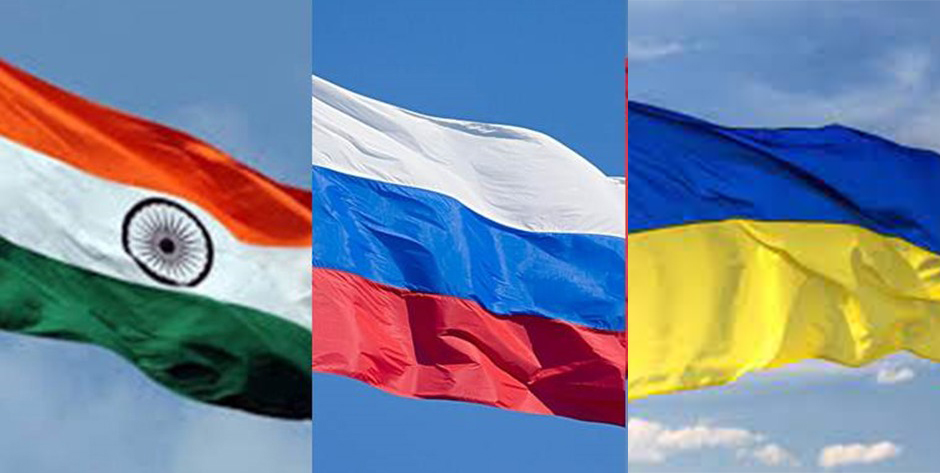
Prime Minister Narendra Modi’s recent visits to Poland and Ukraine are being interpreted by India’s pro-Western analysts as a new warm-up of Indian foreign policy towards Central and Eastern Europe. They see Modi’s visit as an attempt to rebalance India’s relations with Russia and Central Europe (particularly with Russia and Ukraine).
India has not objected to Russia’s operations in Ukraine. India has maintained all kinds of commercial relations with Russia despite the Western embargo against Russia. Recently he visited Moscow and held a meeting with Vladimir Putin. For this reason, Modi’s visit to Ukraine is being seen in pro-Western circles as a belated attempt to revise India’s approach to Russia’s aggression in Ukraine. They argue that India has remained silent on Russia’s unacceptable actions. Even when Russia challenged the core tenets of the Indian worldview on the sanctity of national sovereignty and territorial integrity, India remained silent.
India is paying a political price for this silence on Russian aggression. They think that India has to suffer because Central and Eastern Europe is unhappy with India. But such analysis of India’s foreign policy is poorly informed, shallow and ideologically biased. Because, there is no distance between India and Central and Eastern Europe. This can be understood by looking at the recent record of the visits of the leaders of these countries to India and the visits of Indian leaders to these countries.
In fact, the Russia-Ukraine conflict has created serious problems not only for India, but for the entire international community. The US, Europe and the G-7 stand against Russia. The United States sees Beijing as its biggest adversary—keeping close ties to the West in mind, and China has backed Russia in the Ukraine war for strategic reasons. China values Russia as a partner.
Similarly, while India’s relationship with the West is deep, one must keep in mind that India has a historically close relationship with Russia. For this reason, India is not in a position to abandon either the West or Russia. Because he needs both Washington and Moscow to protect and advance his larger national interests. In fact, the Russia-Ukraine issue is a multi-layered issue.
If Russia has launched a campaign of aggression against Ukraine, the US and its NATO partners have a relatively long list of aggression against other countries. If the fact that US and NATO countries have such a record of aggression does not prevent India from establishing close relations with them, then why would it be wrong to protect India’s relations with Russia? In this case, we should be two-way behavior?
Analyzing the Ukraine conflict from an objective point of view, it will be seen that the responsibility of this war cannot be placed on only one side. This should not be seen as a simple case of violation of a country’s sovereignty and territorial integrity. Because it involves historical legacy, geopolitics, national security, balance of power, ethnic rights, external interference, regime change etc.
This is why India cannot take a simple black-and-white view of the Ukraine conflict. Those who want to exaggerate Western interests should remember that the West’s record of actions on India’s sovereignty and territorial integrity has been adverse to India’s interests and still does not support Indian interests. For this reason, India is not willing to give unconditional support to any side in the Ukraine war.
India feels that it is important for Delhi to have a balanced relationship with both Russia and Ukraine. In maintaining that balance, Delhi’s focus will be on diplomatically dealing with any strategic hindrance from the West.