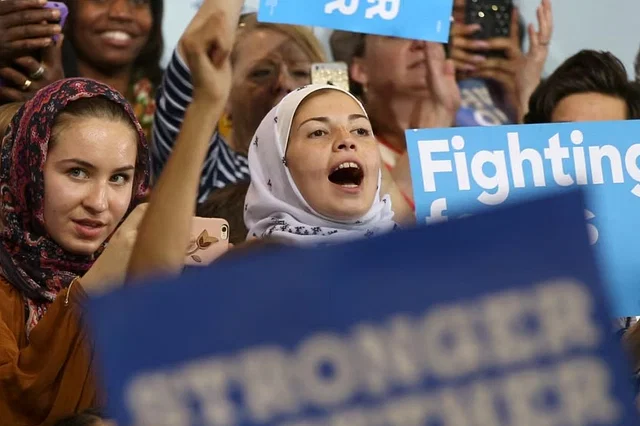
As the US presidential election approaches, efforts to woo voters among political parties are intensifying. Support from the Muslim community has become especially important in areas where swing voters are often contested between Democrats and Republicans.
Although Muslims constitute only 1 percent of the American population; Still they are an important vote bank. Because they are concentrated in all the oscillating regions or swing states where the electoral results are decided by a very small margin of votes.
In this election cycle, the Muslim community seems more united on a single political issue than ever before. That issue is the Gaza war.
In this reality, any candidate who wants to win the votes of a large part of the Muslim electorate must take into account the demands of the Muslim community for an end to the bloodshed in Palestine.
This is what a joint survey report by the research institute Mgaze and Change Research and the Institute for Social Policy and Understanding (ISPU) says.
The survey was conducted from the end of June to the beginning of July last year. The report was created by surveying Muslims in three needle states—Georgia, Pennsylvania, and Michigan—who they would like to vote for in the 2024 presidential election.
In that survey, we saw that Muslims who were big supporters of the Democratic Party in 2020 have become strong opponents of President Joe Biden because of his stance on the Gaza war.
In 2020, 65 percent of Muslim voters in these states voted for Biden. This vote was crucial to his electoral victory as he won key swing states by very narrow margins. In Georgia, Biden won by just 12,000 votes; And more than 61 thousand Muslim voters voted in that state. Similarly, Biden won by 81,000 votes in Pennsylvania, where 125,000 Muslims voted.
But polls conducted in these states now show that only 12 percent of voters there were willing to vote for Biden. At the time the poll was conducted, Biden was a presidential candidate. At that time, Kamala Harris did not come as a presidential candidate.
But the poll suggests that if Biden’s Gaza war policies give the Democratic Party any semblance of a follow-up, Muslim voters will turn away from supporting Biden, as will Kamla Harris.
Through this, it can be assumed that the monopoly of Muslim voters in supporting the Democratic Party has been broken.
No other issue in living memory has united Muslim voters in the United States the way the war in Gaza has.
The ISPU conducted a survey of American Muslims in 2020. That poll found that health care (19 percent), the economy (14 percent) and social justice (13 percent) were the top priorities for Muslims voting. But in a 2024 poll, 61 percent of Muslims in Georgia, Pennsylvania and Michigan prioritized the Gaza war when it came to voting.
Our research shows that, regardless of party affiliation, Muslim voters support reducing military aid to Israel. They see this policy as a reason to vote for the candidate.
Although American positions on other wars going on abroad may seem far removed from the daily concerns of Muslim voters; However, they see America’s unconditional support and diplomatic assistance to Israel as oppression of the Palestinians.
The importance of the Gaza war to Muslim voters was clear months before our survey was conducted.
Activists of a movement (led by Muslims) called the ‘Uncommitted National Movement’ (led by Muslims) in the Democratic primaries called voters ‘Uncommitted’ instead of voting for Biden (there was a box labeled ‘Uncommitted’ next to Joe Biden’s name on the ballot where a tick meant the voter was want to see someone other than Biden as a candidate) called for a vote.
More than 7 lakh ‘uncommitted’ votes were cast in the primary. Through this, the Biden administration was warned to change its tone and policy regarding Israel and Palestine.
Soon after, Trump’s popularity among Muslims in Georgia, Michigan and Pennsylvania was seen to increase.
Kamala Harris has taken the matter seriously since Biden withdrew from the candidacy and is trying to distance herself from Israel’s Gaza war.
Kamala was absent last July when Israeli Prime Minister Netanyahu addressed Congress in Washington. After announcing his name as a presidential candidate, he said he would not remain silent on the plight of Gaza and would continue to push for a ceasefire there.
Considering these aspects, it is understood that the country’s Muslim voters are going to have more influence in the US elections than any other time this year.


![Three smiling women sit on a colorful padded floor, posing with a large sign that reads Canada Child Benefit and its French translation, in a community setting with a pillow saying This Classroom Runs on Kindness nearby.]','Three women pose for a group photo indoors, holding a white board about the Canada Child Benefit and its French equivalent, with colorful circles in the design and a kindness-themed cushion nearby.'] }``` Wait formatting wrong. We must provide proper JSON. Let's craft properly. Provide 5 options. Ensure no stray quotes. Let's produce proper JSON. Use single quotes in descriptions? Must be double quotes. I'll provide array of strings. Ensure no stray characters. Let's do. } For safety. Let's output.} Let's craft final.} Wait earlier included typos. Let's deliver.]]>](https://www.thesouthasiajournal.com/wp-content/uploads/2026/07/12-2-390x220.jpg)