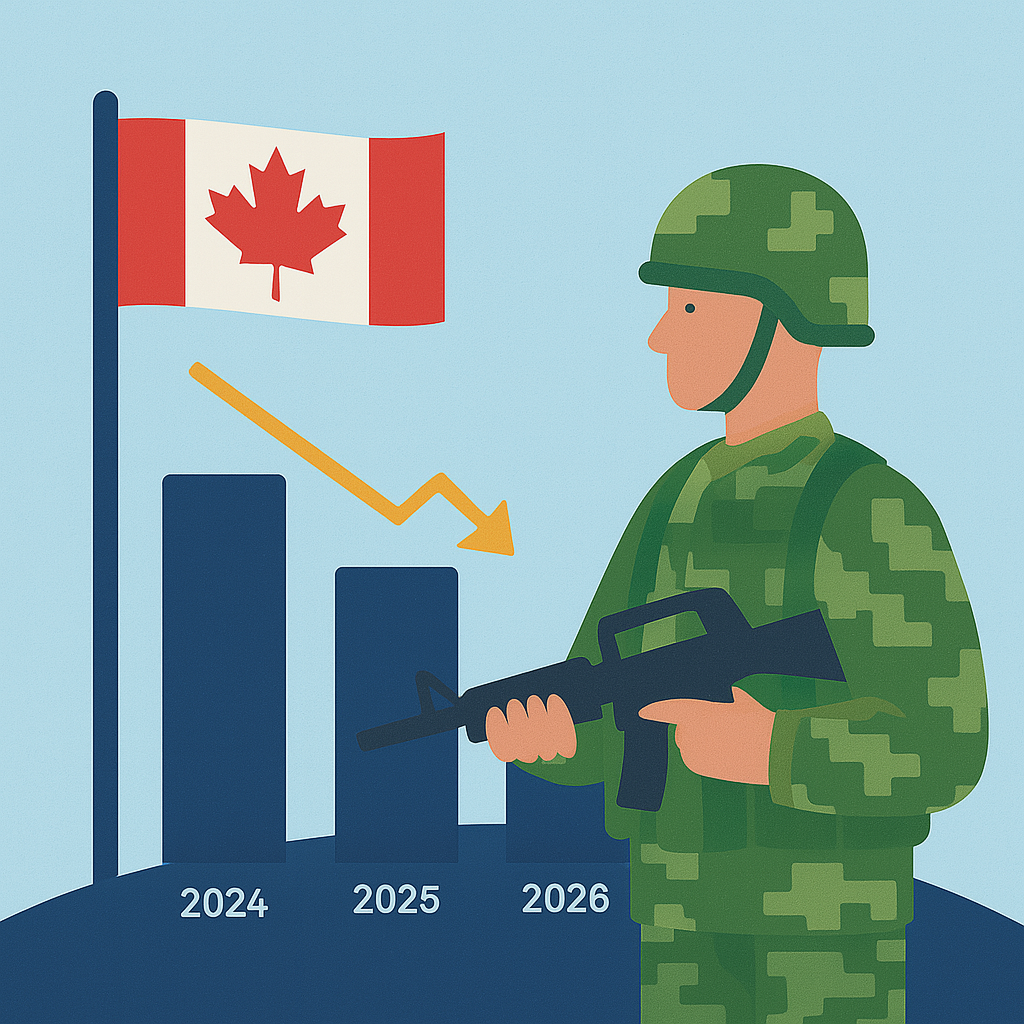
Canada is preparing to bolster its international standing by meeting and even exceeding NATO’s defence spending goals. Prime Minister Mark Carney’s recent pledge to hit the 2% of GDP target by year-end, and an ambitious roadmap to raise that figure to 5% by 2035, is nothing short of historic. But while this military ramp-up may curry favour with allies, let’s not kid ourselves: it won’t be enough to save Canada from the economic storm already hitting our shores.
A newly released report from Oxford Economics gives us the cold, hard reality. Yes, this defence spending will nudge the economy upward by about 0.1 percentage points this year and next. But even with that boost, our GDP growth for 2025 is expected to limp along at just 0.9%. In 2026, it’s predicted to stumble even further to 0.4%. That’s not economic resilience. That’s stagnation with a shiny coat of camouflage paint.
The bigger problem lies in what’s quietly unfolding beneath the surface: a recession triggered by escalating trade tensions with our largest economic partner, the United States. Oxford Economics says the downturn is already underway, estimating a 0.8% contraction in real GDP before we begin to claw our way out likely not until 2026.
Sure, job numbers looked promising last month 83,000 new positions is no small feat but Oxford is clear that this is a temporary blip. The deeper consequences of trade uncertainty are already forcing businesses to freeze investment, slow production, and, inevitably, start laying off workers. The forecast? 140,000 job losses by year-end and unemployment rising to 7.6%. That’s not just a soft landing. That’s a hard crash, softened only slightly by the cushion of recent hiring.
Complicating matters further is how Ottawa plans to fund this defence spree. Oxford Economics assumes a larger federal deficit will foot the bill, which could mean a permanently higher debt-to-GDP ratio. And while the government announced a 15% cut to operational spending last week, it remains unclear how or where those savings will materialize. Without clear offsets, this push to meet NATO expectations risks destabilizing our fiscal foundation.
Even the Bank of Canada has limited room to maneuver. With inflation expected to climb to 3% by mid-2026, interest rate cuts the usual go-to in a recession may be off the table. That leaves policymakers largely paralyzed, unable to deliver meaningful stimulus through lower borrowing costs.
And let’s not forget the housing market. Rising defaults and distressed home sales are very real threats in this environment. Oxford Economics stops short of forecasting a financial crisis, but the mere mention underscores the fragility of our current economic moment.
There’s also a wildcard in all of this: the United States. If Donald Trump follows through on his threat to slap 35% tariffs on Canadian goods starting August 1, this recession could spiral into something much worse. On the flip side, a new economic and security pact could offer much-needed relief but betting Canada’s entire economic fate on unpredictable geopolitics is hardly a strategy.
Still, there’s a silver lining. Compared to 163 other countries, Oxford Economics ranks Canada 27th in economic risk better than China and Japan, but behind the U.S., France, and Australia. So while we may be sliding into a recession, we’re doing it from a position of relative strength.
That’s cold comfort for the Canadians who may lose their jobs, struggle to pay their mortgages, or watch their retirement savings erode. In the end, while it’s good to be strong on defence, no amount of military spending can defend against a recession born of global instability and domestic inaction.
It’s time for Ottawa to recognize that economic security is just as critical as military readiness and demands a far more nuanced, diversified approach.