Canada’s New U.S. Ambassador Walks Tightrope Between Trade Tensions and Diplomatic Optimism
Taslima Jamal
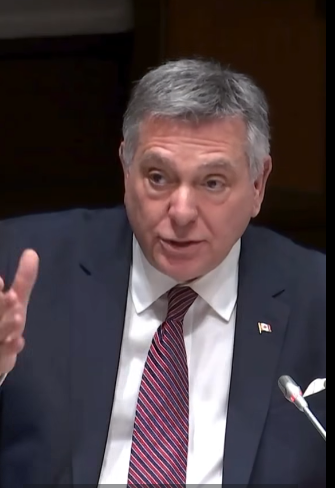
Canada’s freshly appointed ambassador to the United States, Mark Wiseman, struck a carefully balanced tone before Parliament on Thursday, insisting that the deep-rooted bond between Canada and its southern neighbour remains far too vital to walk away from even as the two countries find themselves locked in a bruising trade standoff.
Appearing before the House of Commons foreign affairs committee, Wiseman offered a message that was equal parts reassurance and candid uncertainty. He affirmed Canada’s readiness to negotiate, but could not offer lawmakers a clear timeline for when the current friction might ease.
“Diversifying does not mean abandoning our relationship with the United States of America,” Wiseman told the committee. “It is too big an advantage to us. It is too important to us.”
That message of measured optimism, however, sat somewhat uneasily alongside the blunter remarks of Prime Minister Mark Carney, who earlier in the day described American tariffs on Canadian steel, aluminum, autos and lumber as more than mere annoyances calling them outright violations of the bilateral trade agreement.
At the heart of the current tension is the Canada-U.S.-Mexico Agreement CUSMA which all three signatories must decide whether to renew by July 1 as part of a scheduled review. While the U.S. and Mexico have already confirmed that their formal trade talks will kick off in late May, Wiseman told MPs that no equivalent date has been set for Canada-U.S. negotiations.
Trump administration officials have cast doubt over whether a deal can be reached before the July deadline, pointing to a litany of unresolved disputes and trade irritants with Ottawa. Wiseman, who noted he is not the lead negotiator on CUSMA, said Canada’s position remains that “North American integration must continue to support shared prosperity, but not at the expense of Canada’s autonomy.”
One particularly thorny issue is the future of Canada’s supply management system for dairy a sector U.S. President Donald Trump has repeatedly attacked. Prime Minister Carney has drawn a firm line, vowing it will not be touched during any CUSMA renegotiation. Asked where he stood, Wiseman was remarkably candid: “I don’t think I’ve ever been in agreement with President Trump’s position on this subject and many others.”
Despite the public friction, Wiseman said his private meetings in Washington have been unexpectedly constructive.
“Every meeting that I have had has been respectful, open and receptive. And I have to say, I wasn’t necessarily expecting that,” he told MPs.
He urged observers on both sides of the border to look past the political theatre. “I think at times we have to look below the bluster,” he said, adding that his read of American officials based on several months of engagements is that they too are eager to resolve outstanding issues and get down to business.
Wiseman, who took up the ambassadorial post in February, replacing veteran diplomat Kirsten Hillman, comes to the role with an unconventional background. A former global investment banker and pension fund manager with experience at firms including BlackRock, he has no prior government or diplomatic experience. He acknowledged as much before the committee, but argued that his skills in negotiation and relationship-building are precisely what the moment demands.
Beyond trade, Wiseman said he is working to deepen defence ties with Washington. He noted that Canada’s recent achievement of meeting the NATO target of spending two per cent of GDP on defence “has been welcomed in Washington” and is gaining real attention among American policymakers.
“Americans understand the importance of the alliance and economic relationship with Canada,” he said. “Do they wake up and think about us every day, the way that we wake up and think about them every day? No. And we have to continually remind them of that.”
The committee appearance was not without awkwardness. Near the close of his opening remarks, Wiseman offered an apology for sending an English-only invitation to MPs for an upcoming reception in Washington a mistake that quickly drew public criticism in a country where bilingualism is a matter of national identity and legal obligation.
“It was an error, an unacceptable error, that has now been corrected,” Wiseman said, noting that a bilingual invitation had since been reissued.
Carney had earlier called the oversight “unacceptable,” and the episode arrived at a particularly sensitive moment. Just weeks ago, Air Canada CEO Michael Rousseau faced calls to resign and subsequently announced his retirement after releasing an English-only condolence video following a deadly collision at New York’s LaGuardia Airport.
Wiseman, who does not speak French, sought to assure the committee that he takes seriously his responsibility to represent all Canadians including Francophone and Québécois communities in the U.S. capital.
“I will faithfully represent the policies of the government of Canada as instructed in everything that I do, including as it relates to cultural and language matters,” he said.