Canada Approves Neffy: The Needle-Free Nasal Spray Set to Revolutionize Allergy Emergency Care
Arafat Rahman
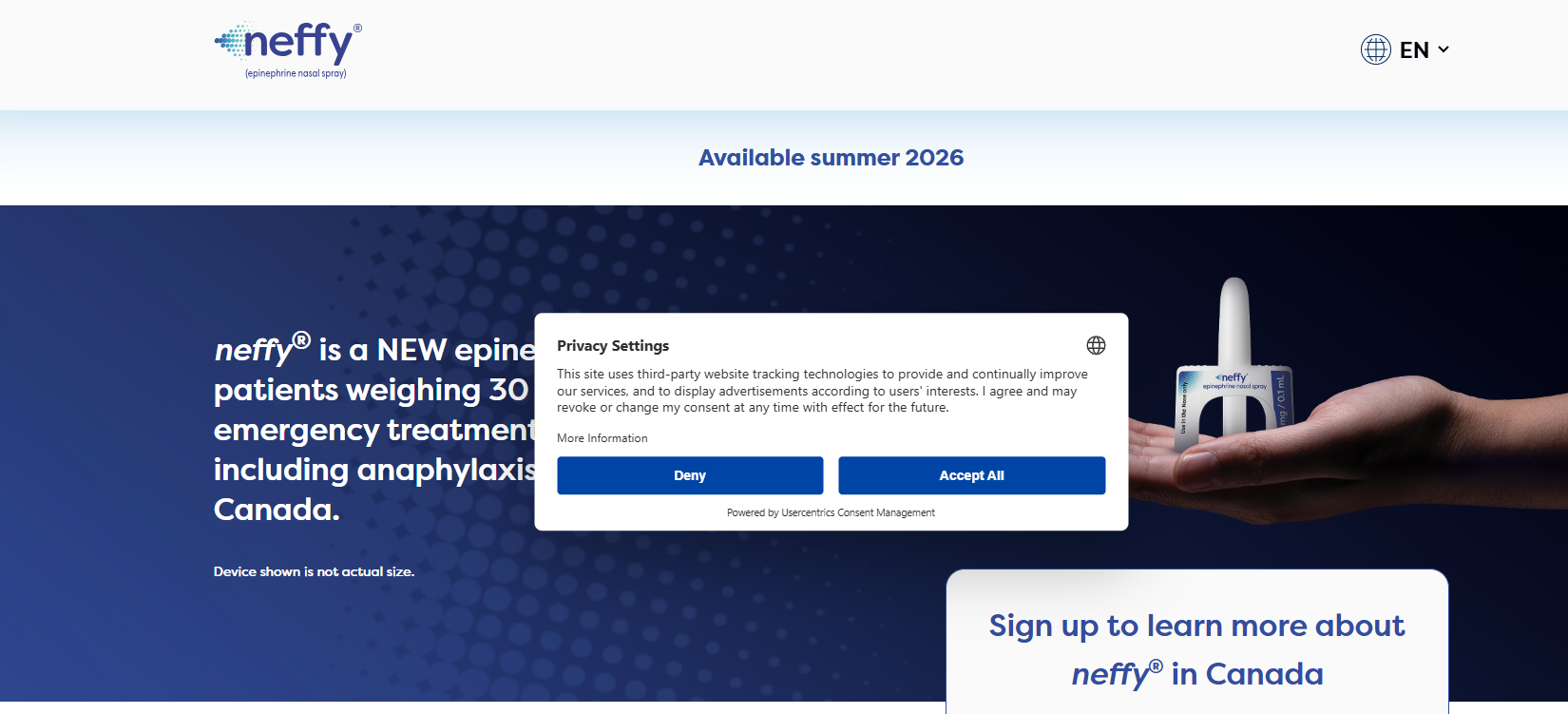
For millions of Canadians living with severe allergies, the fear of anaphylaxis has long come with an added layer of anxiety the needle. That may soon change.
Health Canada has given the green light to Neffy, a first-of-its-kind nasal spray designed to treat life-threatening allergic reactions caused by insect stings, food allergens, and medications. The approval marks a significant shift in how emergency allergy treatment could look for Canadians in the years ahead.
Developed by ALK-Abelló Pharmaceuticals Inc., the pocket-sized device delivers epinephrine through the nose no injection required. It carries a 30-month shelf life and is compact enough to slip into a jacket pocket, making it a potentially more convenient alternative to the EpiPen, which has long been the standard emergency option for people at risk of anaphylaxis.
Until now, Canadians facing anaphylaxis had essentially one option: the epinephrine autoinjector, better known by its brand name EpiPen. While effective, the needle-based device has deterred some patients from carrying or using it when they need it most.
“Before the approval of Neffy, the only thing that we have is the epinephrine autoinjector or the EpiPen which is a needle delivery device,” said Dennis Wong, an associate professor in clinical immunology at the University of Toronto. “But now with Neffy, it could be potentially used for food allergy as well.”
Wong was quick to clarify that Neffy doesn’t treat the underlying allergy itself whether that’s a reaction to peanuts, a bee sting, or a medication. Rather, it addresses the anaphylactic response those triggers can set off. Still, he sees enormous potential in the approval.
“With the nasal delivery device, I think this is going to help a lot of patients feel comfortable,” he said. “I foresee, or I hope in the future, more patients will be willing to use epinephrine in those situations.” He went further, calling it a potential “game changer for a lot of patients.”
Derek Chu, a Chair in Allergy at the Canadian Institutes of Health Research (CIHR), echoed that enthusiasm with measured optimism.
“If you ask many people that have used an EpiPen, they’ll actually say, ‘Oh, that was a lot easier than I thought it was going to be,'” Chu noted. Even so, he acknowledged that perception matters. For those who balk at the idea of self-injecting during a medical emergency, having a needle-free option could be the difference between acting fast and hesitating.
“Additional products are very welcome,” Chu said. “Having one of these medications available is going to be crucial.”
But he also flagged an important concern: access. Chu stressed that Neffy must be priced and insured in a way that ensures equitable availability for everyone who needs it not just those who can afford it out of pocket.
One group that stands to benefit considerably is children. Millions of Canadian kids under 18 carry food allergies, and many of them are required to have emergency medication on hand at school and during activities. The bulky EpiPen pouch has, for some, become a source of self-consciousness.
“There are kids who have to carry the EpiPen pouch and sometimes other kids point out, ‘Hey, what’s that?’ and it might not be a very comfortable thing for the kid to necessarily carry around,” Wong said. “The Neffy is really compact and that can really help with those situations.”
According to Food Allergy Canada, over three million Canadians report having at least one food allergy, with more than 600,000 of them being children. ALK Canada estimates that roughly 2.5 million Canadians overall suffer from severe allergies a considerable population that could benefit from expanded treatment options.
Neffy is already available in the United States, the United Kingdom, and parts of Europe. Canadian consumers, however, will need to wait a little longer. ALK Canada says the product is expected to reach pharmacy shelves this summer.
Wong is hopeful the approval signals a broader shift in the Canadian market.
“In the past, there were other injectors, but those are even not in the market anymore, so we’re only left with one option,” he said. “So now having a second option that is needle-free is making a huge difference.”
Both Wong and Chu urge Canadians with severe allergies not to make unilateral decisions about switching medications. As Neffy rolls out, the recommendation is straightforward: consult your doctor.
“See your clinician, your allergist, your specialist as we roll this out and make a shared decision about how they want to see things going forward,” Chu advised.
For now, the approval itself is being welcomed as a meaningful step forward one that could make emergency allergy treatment feel a little less daunting for millions of Canadians.