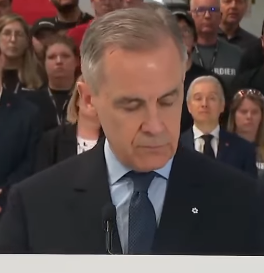
The world is once again feeling the tremors of President Donald Trump’s trade aggression, and Canada stands at the heart of the storm. But unlike in past years, the country now has a new — and arguably untested — leader trying to steer it through the turbulence: Prime Minister Mark Carney.
As Trump reignites his global tariff crusade, rattling markets and allies alike, Carney has found himself in a high-stakes balancing act. On Friday, he briefly stepped off the campaign trail — for the third time — to regroup with his cabinet committee on Canada-U.S. relations and national security. It was a symbolic gesture, yes, but also a necessary one. In a world where Washington wields tariffs like weapons, Canada can’t afford to be caught flat-footed.
“We reviewed our response to those tariffs, our core strategy of to fight, to protect and to build,” Carney told reporters following the meeting. It’s a neat slogan. But behind those words is the real grit of politics and economic survival — and a lot of uncertainty.
Trump’s latest round of “reciprocal” tariffs, initially aimed at over 75 countries, has sent global markets into a tailspin. Though he’s hit pause on that plan, Canada remains conspicuously excluded from the reprieve list. Instead, we’re staring down three brutal tariffs already in effect: steel and aluminum, auto sector, and a general export crackdown on goods not compliant with CUSMA. Let that sink in — the rest of the world gets breathing room, and Canada gets the boot.
It’s no wonder Carney is playing both caretaker and crisis manager. He wants to ensure that whoever wins the upcoming federal election has the leverage needed when negotiations with Trump kick off in early May. That’s leadership that’s thinking beyond party lines — a refreshing approach in our hyper-partisan age.
But the criticisms are pouring in. Conservative Leader Pierre Poilievre has accused Carney of over-promising, noting “he has no control over President Trump.” True. No one does. But then again, when has that ever been the measure of a Canadian prime minister’s worth? Leadership isn’t about controlling chaos — it’s about navigating it.
NDP Leader Jagmeet Singh, for his part, has backed the retaliatory tariffs, a rare moment of consensus in today’s fragmented political landscape. Canada has already hit back with tariffs on nearly $60 billion worth of American goods — including a big blow to U.S.-made vehicles. It’s a sharp response, but one that speaks more to necessity than strategy. We’re not posturing anymore. We’re defending.
So where does that leave us?
In a precarious but not hopeless place. Carney’s decision to suspend his campaign and focus on economic defense shows he’s aware of what’s truly at stake. This isn’t just about trade — it’s about sovereignty, stability, and Canada’s ability to stand its ground in an increasingly hostile global economy.
With the federal election looming on April 28, Canadians are not just voting for a government. They’re voting on how they want their country to engage with a superpower gone rogue. Trump’s threats — even his absurd “51st state” jabs — may seem theatrical, but the consequences are very real.
The next prime minister — whether it’s Carney, Poilievre, or Singh — won’t just need a good slogan. They’ll need a spine of steel and a strategy grounded in realism. Because the storm isn’t coming. It’s already here.
And how we respond now will define our place in the world for years to come.