
After months of conflict that rattled global energy markets and sent fuel costs surging, the United States and Iran have agreed to a peace deal. U.S. President Donald Trump broke the news Sunday on his Truth Social platform, a development later confirmed by Pakistan’s prime minister, who has been serving as a diplomatic go-between throughout negotiations.
Trump was bullish in his announcement, declaring that energy prices would “drop like a rock” once the Strait of Hormuz is reopened to shipping. But energy analysts and economists are urging caution painting a far more complicated picture of what lies ahead for consumers still wincing at the gas pump.
Previous ceasefire claims from the Trump administration had repeatedly fallen apart, leaving markets skeptical. This time, however, experts say the involvement of third parties changes the calculus.
“The deliberate inclusion of other parties is what makes this different,” said David Detomasi, a professor of international business at Queen’s University’s Smith School of Business. Having Pakistan formally confirm the agreement rather than a one-sided announcement signals a more durable arrangement.
The peace deal is set to be formally signed in Switzerland this Friday.
Still, a signed agreement is only step one. For energy markets to truly exhale, tankers need to actually start moving again through the Strait of Hormuz the narrow chokepoint through which roughly a fifth of the world’s oil supply passes.
“The number one thing we will need to see is actual movement of ships through the strait,” said Marc Ercolao, an economist at TD Economics. “That’s what’s been holding back global oil supply.”
Even if the strait reopens smoothly, the road to energy market recovery is far longer than Trump’s optimistic framing suggests. Economists point out that damage to oil infrastructure on both sides of the strait has created compounding bottlenecks that won’t be resolved overnight.
“Even if you open up the strait, that doesn’t necessarily mean oil can flow freely if it’s bottlenecked by not being able to reach the port in the first place,” said Moshe Lander, an economics professor at Concordia University. Damaged facilities near the strait’s entrance would need imported parts and materials to be repaired a process that could add another several months to any meaningful price recovery.
The broader supply chain damage extends beyond oil alone. Natural gas, fertilizer, and numerous other commodities that flow through the Persian Gulf region have all been disrupted, leaving markets far from ready to snap back to February levels.
As of this report, U.S. benchmark crude (West Texas Intermediate) was trading at around $80 per barrel down sharply from a conflict-era peak of $113 in May, but still well above the roughly $65 it sat at before hostilities began in February.
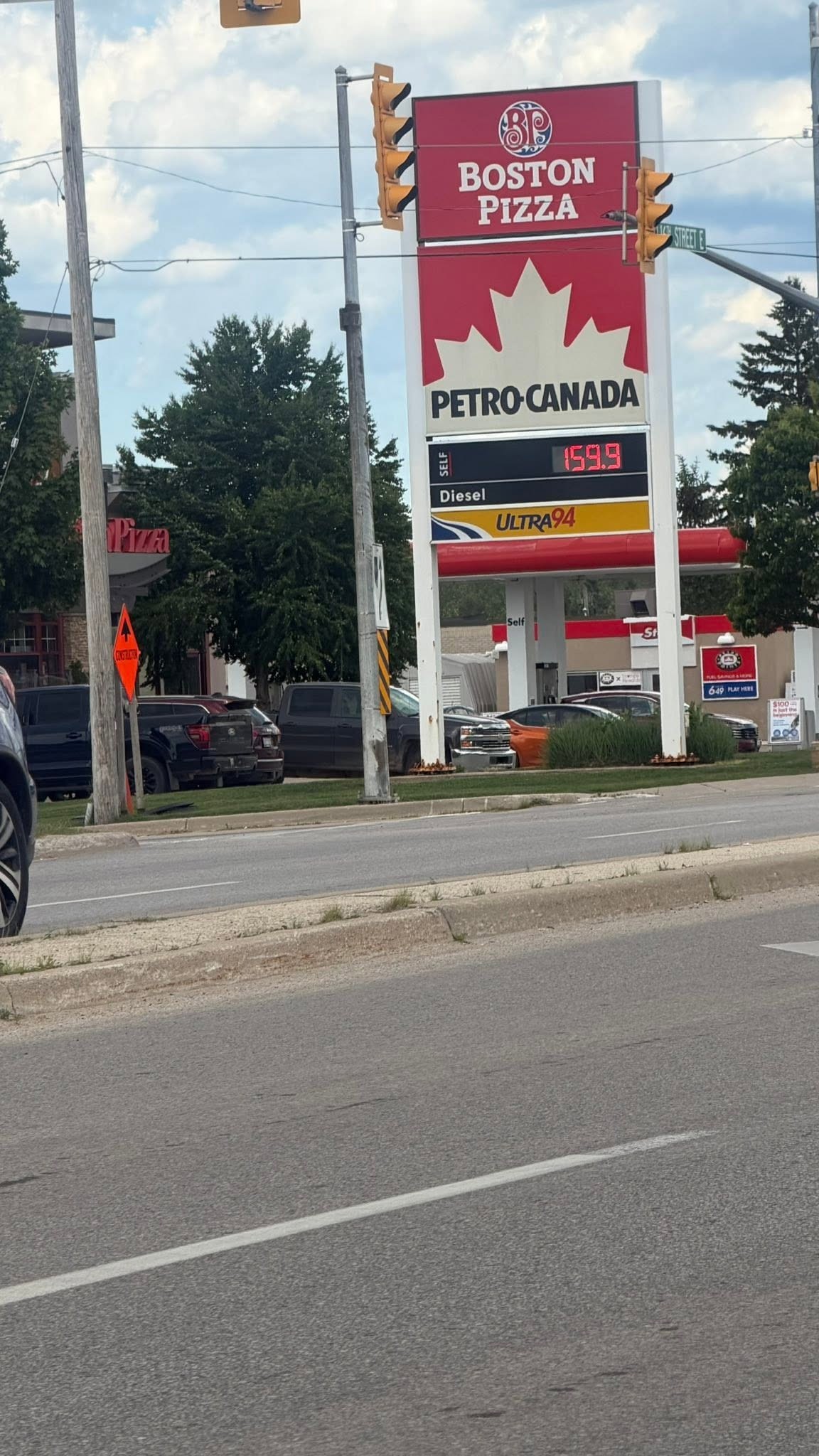
At the pump, Canadians have been paying a national average of just under $1.66 per litre for regular gasoline, according to CAA data. That’s a drop from a painful high of around $1.90 a month ago, though it remains dramatically higher than the $1.35 per litre consumers were paying one year ago and some regions saw prices climb past $2.00.
Gas price analyst Dan McTeague of Canadians for Affordable Energy expects Canadians to see a further drop of roughly 10 to 15 cents per litre in the coming days and weeks as markets price in the ceasefire. But he’s cautious about expectations beyond that.
“We’re not going back to $1.30 or $1.35 on average,” McTeague said, pointing to the sheer volume of supply shortages that have accumulated. Crude vessels are slow crossing oceans takes weeks and the physical damage to Persian Gulf oil fields adds further delays before supply levels normalize.
“It’s going to take a long time for things to get back to normal that means higher prices for longer,” he said.
Underlying all of this is a more unsettling question: even if the conflict ends cleanly and supply chains heal, will prices ever return to where they were?
Lander estimates it could take three to four months for crude oil to fall back toward the $60-per-barrel range and only if the peace deal holds, repairs proceed without delay, and shipments ramp back up to pre-war volumes. A full normalization of retail gas prices could take until the end of 2026, or even into 2027.
Ercolao put it more bluntly: “We might not even get back to pre-war levels, but we will definitely get back to manageable energy levels into 2027.”
Detomasi took the broadest view of what this moment reveals. The world, he argues, has entered an era of recurring energy shocks geopolitical flare-ups, supply disruptions, and market volatility that were once considered rare exceptions have now become an expected part of the landscape.
“We got comfortable with the fact that shocks were rare and that we could deal with them when they happen,” he said. “Now they happen all the time this is the new normal.”